Csurka, Gabriela Author
Biography not available.

Browse all FOLKLORE books
Browse all GARDENS books
Browse all GRAPHIC NOVELS books
Browse all HISTORY - MEDIEVAL books
Browse all HUMOUR books
Browse all Juvenile Fiction : Biographical - Other books
Browse all Juvenile Fiction : Historical - Other books
Browse all Juvenile Fiction : Legends, Myths, & Fables - Other books
Browse all Juvenile Fiction : People & Places - Other books
Browse all Juvenile Fiction : People & Places - United States - Other books
Browse all Juvenile Fiction : Religious - Other books
Browse all Juvenile Nonfiction : History - Other books
Browse all Juvenile Nonfiction : Mathematics - Advanced books
Browse all Juvenile Nonfiction : People & Places - Other books
Browse all Juvenile Nonfiction : People & Places - United States - Othe books
Browse all LITERARY STUDIES books
Browse all LONDON books
Browse all Medical : Nursing - Mental Health books
Browse all MIND books
Browse all MUSEOLOGY books
Browse all NON-CLASSIFIABLE books
Browse all NONLINEAR SCIENCE books
Browse all POPULAR SCIENCE books
Browse all RELIGIOUS STUDIES books
Browse all SPIRIT books
Browse all SPORT books
Browse all TRAVEL WRITING books
 Out of Stock
Paperback · ISBN 9783031791703
Inclusive of GST and other taxes
Arriving at your doorstep in 10-15 days
Our logisitcs team will make sure everyitem is delivered safely
| ISBN | 9783031791703 |
|---|---|
| Publisher | Springer |
| Publication date | April 2022 |
| Language | English |
| MRP | £43.99 GBP |
| Page count | 192 |
| Item weight | 75 g |
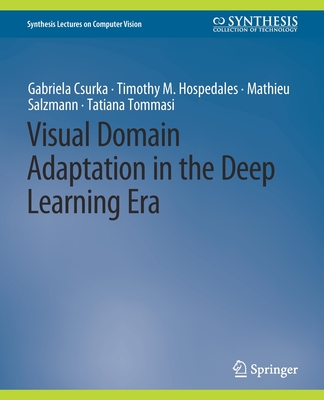
Solving problems with deep neural networks typically relies on massive amounts of labeled training data to achieve high performance. While in many situations huge volumes of unlabeled data can be and often are generated and available, the cost of acquiring data labels remains high. Transfer learning (TL), and in particular domain adaptation (DA), has emerged as an effective solution to overcome the burden of annotation, exploiting the unlabeled data available from the target domain together with labeled data or pre-trained models from similar, yet different source domains. The aim of this book is to provide an overview of such DA/TL methods applied to computer vision, a field whose popularity has increased significantly in the last few years. We set the stage by revisiting the theoretical background and some of the historical shallow methods before discussing and comparing different domain adaptation strategies that exploit deep architectures for visual recognition. We introduce the space of self-training-based methods that draw inspiration from the related fields of deep semi-supervised and self-supervised learning in solving the deep domain adaptation. Going beyond the classic domain adaptation problem, we then explore the rich space of problem settings that arise when applying domain adaptation in practice such as partial or open-set DA, where source and target data categories do not fully overlap, continuous DA where the target data comes as a stream, and so on. We next consider the least restrictive setting of domain generalization (DG), as an extreme case where neither labeled nor unlabeled target data are available during training. Finally, we close by considering the emerging area of learning-to-learn and how it can be applied to further improve existing approaches to cross domain learning problems such as DA and DG.
Log in to write a review for this book.
No reviews yet. Be the first to share your opinion.
Biography not available.
Biography not available.
Biography not available.