Lorek, Pawel Author
Biography not available.

Browse all FOLKLORE books
Browse all GARDENS books
Browse all GRAPHIC NOVELS books
Browse all HISTORY - MEDIEVAL books
Browse all HUMOUR books
Browse all Juvenile Fiction : Biographical - Other books
Browse all Juvenile Fiction : Historical - Other books
Browse all Juvenile Fiction : Legends, Myths, & Fables - Other books
Browse all Juvenile Fiction : People & Places - Other books
Browse all Juvenile Fiction : People & Places - United States - Other books
Browse all Juvenile Fiction : Religious - Other books
Browse all Juvenile Nonfiction : History - Other books
Browse all Juvenile Nonfiction : Mathematics - Advanced books
Browse all Juvenile Nonfiction : People & Places - Other books
Browse all Juvenile Nonfiction : People & Places - United States - Othe books
Browse all LITERARY STUDIES books
Browse all LONDON books
Browse all Medical : Nursing - Mental Health books
Browse all MIND books
Browse all MUSEOLOGY books
Browse all NON-CLASSIFIABLE books
Browse all NONLINEAR SCIENCE books
Browse all POPULAR SCIENCE books
Browse all RELIGIOUS STUDIES books
Browse all SPIRIT books
Browse all SPORT books
Browse all TRAVEL WRITING books
 Out of Stock
Hardback · ISBN 9783032011893
Inclusive of GST and other taxes
Arriving at your doorstep in 10-15 days
Our logisitcs team will make sure everyitem is delivered safely
| ISBN | 9783032011893 |
|---|---|
| Publisher | Springer |
| Publication date | November 2025 |
| Language | English |
| MRP | £59.99 GBP |
| Page count | 650 |
| Item weight | 238 g |
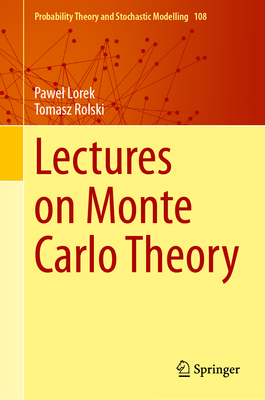
This book presents a broad range of computational techniques based on repeated random sampling, widely known as Monte Carlo methods and sometimes as stochastic simulation. These methods bring together ideas from probability theory, statistics, computer science, and statistical physics, providing tools for solving problems in fields such as operations research, biotechnology, and finance.</p> Topics include the generation and analysis of pseudorandom numbers (which are intended to imitate truly random numbers on a computer), the design and justification of Monte Carlo algorithms, and advanced approaches such as Markov chain Monte Carlo and stochastic optimization. In contrast to deterministic numerical methods, the outcome of a Monte Carlo algorithm is itself random - and one needs the tools of probability and statistics to interpret these results meaningfully. The theoretical foundations, particularly the law of large numbers and central limit theorem, are combined with practical algorithms that reveal both the strengths and subtleties of stochastic simulation.</p> The book includes numerous exercises, both theoretical and computational. Each chapter features step-by-step algorithms, illustrated examples, and results presented through numerical computations, tables, and a variety of plots and figures. All Python code used to produce these results is publicly available, allowing readers to reproduce and explore simulations on their own.</p> Intended primarily for graduate students and researchers, the exposition focuses on core concepts and intuitive understanding, avoiding excessive formalism. The book is suitable both for self-study and as a course text and offers a clear pathway from foundational principles to modern applications.</p>
Log in to write a review for this book.
No reviews yet. Be the first to share your opinion.
Biography not available.
Biography not available.