Soulis, Konstantinos, X. Author
Biography not available.

Browse all FOLKLORE books
Browse all GARDENS books
Browse all GRAPHIC NOVELS books
Browse all HISTORY - MEDIEVAL books
Browse all HUMOUR books
Browse all Juvenile Fiction : Biographical - Other books
Browse all Juvenile Fiction : Historical - Other books
Browse all Juvenile Fiction : Legends, Myths, & Fables - Other books
Browse all Juvenile Fiction : People & Places - Other books
Browse all Juvenile Fiction : People & Places - United States - Other books
Browse all Juvenile Fiction : Religious - Other books
Browse all Juvenile Nonfiction : History - Other books
Browse all Juvenile Nonfiction : Mathematics - Advanced books
Browse all Juvenile Nonfiction : People & Places - Other books
Browse all Juvenile Nonfiction : People & Places - United States - Othe books
Browse all LITERARY STUDIES books
Browse all LONDON books
Browse all Medical : Nursing - Mental Health books
Browse all MIND books
Browse all MUSEOLOGY books
Browse all NON-CLASSIFIABLE books
Browse all NONLINEAR SCIENCE books
Browse all POPULAR SCIENCE books
Browse all RELIGIOUS STUDIES books
Browse all SPIRIT books
Browse all SPORT books
Browse all TRAVEL WRITING books
 Out of Stock
Hardback · ISBN 9783036508207
Inclusive of GST and other taxes
Arriving at your doorstep in 10-15 days
Our logisitcs team will make sure everyitem is delivered safely
| ISBN | 9783036508207 |
|---|---|
| Publisher | MDPI AG |
| Publication date | June 2021 |
| Language | English |
| MRP | £43.00 GBP |
| Page count | 172 |
| Item weight | 127 g |
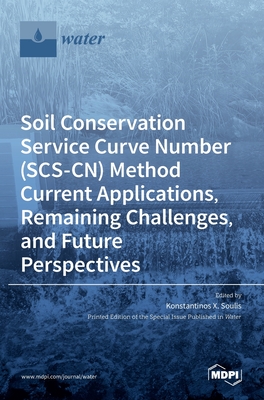
Probably, the most well-documented, and at the same time, simple conceptual method for predicting runoff depth from rainfall depth is the Soil Conservation Service curve number (SCS-CN) method. This Special Issue presents the latest developments in the SCS-CN methodology, including, but not limited to, novel applications, theoretical and conceptual studies broadening the current understanding, studies extending the method's application in other geographical regions or other scientific fields, substantial evaluation studies, and ultimately, key advancements towards addressing the key remaining challenges, such as: improving the SCS-CN method runoff predictions without sacrificing its current level of simplicity; moving towards a unique generally accepted procedure for CN determination from rainfall-runoff data; improving the initial abstraction estimation; investigating the integration of SCS-CN method in long-term continuous hydrological models and the implementation of various soil moisture accounting systems; extending and adopting the existing CNs documentation in a broader range of regions, land uses and climatic conditions; and utilizing novel modeling, geoinformation systems, and remote sensing techniques to improve the performance and the efficiency of the method.
Log in to write a review for this book.
No reviews yet. Be the first to share your opinion.
Biography not available.