De Luca, Davide , Luciano Author
Biography not available.

Browse all FOLKLORE books
Browse all GARDENS books
Browse all GRAPHIC NOVELS books
Browse all HISTORY - MEDIEVAL books
Browse all HUMOUR books
Browse all Juvenile Fiction : Biographical - Other books
Browse all Juvenile Fiction : Historical - Other books
Browse all Juvenile Fiction : Legends, Myths, & Fables - Other books
Browse all Juvenile Fiction : People & Places - Other books
Browse all Juvenile Fiction : People & Places - United States - Other books
Browse all Juvenile Fiction : Religious - Other books
Browse all Juvenile Nonfiction : History - Other books
Browse all Juvenile Nonfiction : Mathematics - Advanced books
Browse all Juvenile Nonfiction : People & Places - Other books
Browse all Juvenile Nonfiction : People & Places - United States - Othe books
Browse all LITERARY STUDIES books
Browse all LONDON books
Browse all Medical : Nursing - Mental Health books
Browse all MIND books
Browse all MUSEOLOGY books
Browse all NON-CLASSIFIABLE books
Browse all NONLINEAR SCIENCE books
Browse all POPULAR SCIENCE books
Browse all RELIGIOUS STUDIES books
Browse all SPIRIT books
Browse all SPORT books
Browse all TRAVEL WRITING books
 Out of Stock
Hardback · ISBN 9783036557472
Inclusive of GST and other taxes
Arriving at your doorstep in 10-15 days
Our logisitcs team will make sure everyitem is delivered safely
| ISBN | 9783036557472 |
|---|---|
| Publisher | MDPI AG |
| Publication date | December 2022 |
| Language | English |
| MRP | £67.39 GBP |
| Page count | 228 |
| Item weight | 153 g |
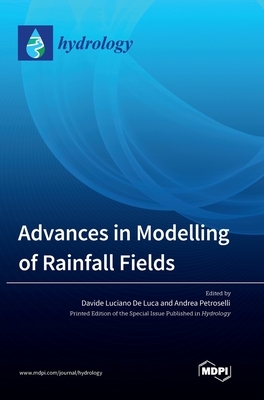
Rainfall is the main input for all hydrological models, such as rainfall-runoff models and the forecasting of landslides triggered by precipitation, with its comprehension being clearly essential for effective water resource management as well. The need to improve the modeling of rainfall fields constitutes a key aspect both for efficiently realizing early warning systems and for carrying out analyses of future scenarios related to occurrences and magnitudes for all induced phenomena. The aim of this Special Issue was hence to provide a collection of innovative contributions for rainfall modeling, focusing on hydrological scales and a context of climate changes.
We believe that the contribution from the latest research outcomes presented in this Special Issue can shed novel insights on the comprehension of the hydrological cycle and all the phenomena that are a direct consequence of rainfall. Moreover, all these proposed papers can clearly constitute a valid base of knowledge for improving specific key aspects of rainfall modeling, mainly concerning climate change and how it induces modifications in properties such as magnitude, frequency, duration, and the spatial extension of different types of rainfall fields. The goal should also consider providing useful tools to practitioners for quantifying important design metrics in transient hydrological contexts (quantiles of assigned frequency, hazard functions, intensity-duration-frequency curves, etc.).
Log in to write a review for this book.
No reviews yet. Be the first to share your opinion.
Biography not available.
Biography not available.