No Contributor Author
Biography not available.

Browse all FOLKLORE books
Browse all GARDENS books
Browse all GRAPHIC NOVELS books
Browse all HISTORY - MEDIEVAL books
Browse all HUMOUR books
Browse all Juvenile Fiction : Biographical - Other books
Browse all Juvenile Fiction : Historical - Other books
Browse all Juvenile Fiction : Legends, Myths, & Fables - Other books
Browse all Juvenile Fiction : People & Places - Other books
Browse all Juvenile Fiction : People & Places - United States - Other books
Browse all Juvenile Fiction : Religious - Other books
Browse all Juvenile Nonfiction : History - Other books
Browse all Juvenile Nonfiction : Mathematics - Advanced books
Browse all Juvenile Nonfiction : People & Places - Other books
Browse all Juvenile Nonfiction : People & Places - United States - Othe books
Browse all LITERARY STUDIES books
Browse all LONDON books
Browse all Medical : Nursing - Mental Health books
Browse all MIND books
Browse all MUSEOLOGY books
Browse all NON-CLASSIFIABLE books
Browse all NONLINEAR SCIENCE books
Browse all POPULAR SCIENCE books
Browse all RELIGIOUS STUDIES books
Browse all SPIRIT books
Browse all SPORT books
Browse all TRAVEL WRITING books
 Out of Stock
Paperback · ISBN 9783110778144
Inclusive of GST and other taxes
Arriving at your doorstep in 10-15 days
Our logisitcs team will make sure everyitem is delivered safely
| ISBN | 9783110778144 |
|---|---|
| Publisher | De Gruyter Mouton |
| Publication date | December 2021 |
| Language | English |
| MRP | £31.50 GBP |
| Page count | 624 |
| Item weight | 190 g |
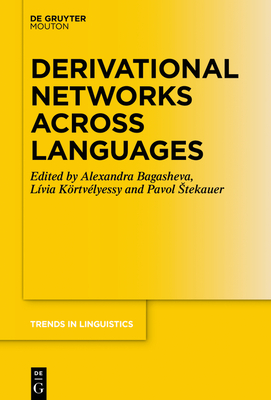
This pioneering research brings a new insight into derivational processes in terms of theory, method and typology.
Theoretically, it conceives of derivation as a three-dimensional system. Methodologically, it introduces a range of parameters for the evaluation of derivational networks, including the derivational role, combinability and blocking effects of semantic categories, the maximum derivational potential and its actualization in relation to simple underived words, and the maximum and average number of orders of derivation.
Each language-specific chapter has a unified structure, which made it possible to identify - in the final, typologically oriented chapter - the systematicity and regularity in developing derivational networks in a sample of forty European languages and in a few language genera and families. This is supported by considerations about the role of word-classes, morphological types, and the differences and similarities between word-formation processes of the languages belonging to the same genus/family.
Log in to write a review for this book.
No reviews yet. Be the first to share your opinion.
Biography not available.