Sotiropoulos, Dionisios N. Author
Biography not available.

Browse all FOLKLORE books
Browse all GARDENS books
Browse all GRAPHIC NOVELS books
Browse all HISTORY - MEDIEVAL books
Browse all HUMOUR books
Browse all Juvenile Fiction : Biographical - Other books
Browse all Juvenile Fiction : Historical - Other books
Browse all Juvenile Fiction : Legends, Myths, & Fables - Other books
Browse all Juvenile Fiction : People & Places - Other books
Browse all Juvenile Fiction : People & Places - United States - Other books
Browse all Juvenile Fiction : Religious - Other books
Browse all Juvenile Nonfiction : History - Other books
Browse all Juvenile Nonfiction : Mathematics - Advanced books
Browse all Juvenile Nonfiction : People & Places - Other books
Browse all Juvenile Nonfiction : People & Places - United States - Othe books
Browse all LITERARY STUDIES books
Browse all LONDON books
Browse all Medical : Nursing - Mental Health books
Browse all MIND books
Browse all MUSEOLOGY books
Browse all NON-CLASSIFIABLE books
Browse all NONLINEAR SCIENCE books
Browse all POPULAR SCIENCE books
Browse all RELIGIOUS STUDIES books
Browse all SPIRIT books
Browse all SPORT books
Browse all TRAVEL WRITING books
 Out of Stock
Hardback · ISBN 9783319471921
Inclusive of GST and other taxes
Arriving at your doorstep in 10-15 days
Our logisitcs team will make sure everyitem is delivered safely
| ISBN | 9783319471921 |
|---|---|
| Publisher | Springer |
| Publication date | November 2016 |
| Language | English |
| MRP | £89.99 GBP |
| Page count | 344 |
| Item weight | 145 g |
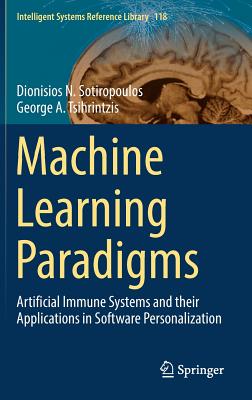
The topic of this monograph falls within the, so-called, biologically motivated computing paradigm, in which biology provides the source of models and inspiration towards the development of computational intelligence and machine learning systems. Specifically, artificial immune systems are presented as a valid metaphor towards the creation of abstract and high level representations of biological components or functions that lay the foundations for an alternative machine learning paradigm. Therefore, focus is given on addressing the primary problems of Pattern Recognition by developing Artificial Immune System-based machine learning algorithms for the problems of Clustering, Classification and One-Class Classification. Pattern Classification, in particular, is studied within the context of the Class Imbalance Problem. The main source of inspiration stems from the fact that the Adaptive Immune System constitutes one of the most sophisticated biological systems that is exceptionally evolved in order to continuously address an extremely unbalanced pattern classification problem, namely, the self / non-self discrimination process. The experimental results presented in this monograph involve a wide range of degenerate binary classification problems where the minority class of interest is to be recognized against the vast volume of the majority class of negative patterns. In this context, Artificial Immune Systems are utilized for the development of personalized software as the core mechanism behind the implementation of Recommender Systems.
The book will be useful to researchers, practitioners and graduate students dealing with Pattern Recognition and Machine Learning and their applications in Personalized Software and Recommender Systems. It is intended for both the expert/researcher in these fields, as well as for the general reader in the field of Computational Intelligence and, more generally, Computer Science who wishes to learn more about the field of Intelligent Computing Systems and its applications. An extensive list of bibliographic references at the end of each chapter guides the reader to probe further into application area of interest to him/her.
Log in to write a review for this book.
No reviews yet. Be the first to share your opinion.
Biography not available.
Biography not available.