Cooper, Barry S. Editor
Biography not available.

Browse all FOLKLORE books
Browse all GARDENS books
Browse all GRAPHIC NOVELS books
Browse all HISTORY - MEDIEVAL books
Browse all HUMOUR books
Browse all Juvenile Fiction : Biographical - Other books
Browse all Juvenile Fiction : Historical - Other books
Browse all Juvenile Fiction : Legends, Myths, & Fables - Other books
Browse all Juvenile Fiction : People & Places - Other books
Browse all Juvenile Fiction : People & Places - United States - Other books
Browse all Juvenile Fiction : Religious - Other books
Browse all Juvenile Nonfiction : History - Other books
Browse all Juvenile Nonfiction : Mathematics - Advanced books
Browse all Juvenile Nonfiction : People & Places - Other books
Browse all Juvenile Nonfiction : People & Places - United States - Othe books
Browse all LITERARY STUDIES books
Browse all LONDON books
Browse all Medical : Nursing - Mental Health books
Browse all MIND books
Browse all MUSEOLOGY books
Browse all NON-CLASSIFIABLE books
Browse all NONLINEAR SCIENCE books
Browse all POPULAR SCIENCE books
Browse all RELIGIOUS STUDIES books
Browse all SPIRIT books
Browse all SPORT books
Browse all TRAVEL WRITING books
 Out of Stock
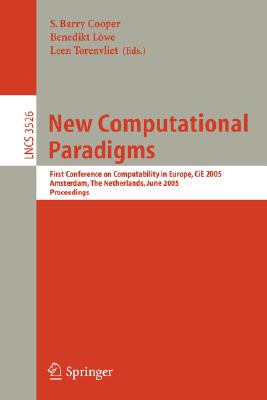
NEW COMPUTATIONAL PARADIGMS 20
Paperback · ISBN 9783540261797
Inclusive of GST and other taxes
Arriving at your doorstep in 10-15 days
Our logisitcs team will make sure everyitem is delivered safely
| ISBN | 9783540261797 |
|---|---|
| Subtitle | NEW COMPUTATIONAL PARADIGMS 20 |
| Publisher | Springer |
| Publication date | May 2005 |
| Language | English |
| MRP | £89.99 GBP |
| Page count | 600 |
| Item weight | 183 g |
CiE 2005: New Computational Paradigms http: //www. illc. uva. nl/CiE/ ThecooperationComputabilityinEurope (CiE)isaninformalEuropeannetwork covering computability in theoretical computer science and mathematical logic, ranging from application of novel approaches to computation to set-theoretic analysesofin?nitarycomputingmodels. Thecooperationconsistsofelevenmain nodesandincludesover400researchers;itiscoordinatedfromLeeds(UK). More information about CiE can be found in Barry Cooper's introductory paper to this volume (p. 1) and at http: //www. amsta. leeds. ac. uk/pure/staff/cooper/cie. html CiE 2005 was a conference on the special topic "New Computational Pa- digms" and was held in Amsterdam in June 2005. It was initiated by and served as a focus point for the informal cooperation CiE. The topic of "New Com- tational Paradigms" covers connections between computation and physical s- tems (e. g., quantum computation, neural nets, molecular computation) but also higher mathematical models of computation (e. g., in?nitary computation or real computation). Computability theory is central to large areas of theoretical computer science and mathematical logic. Traditionally, the computational model of the Turing machine (or mathematically equivalent models) has been used to reason about computation or computability. For general computability inquiries (with - bounded resources), the choice of the model of computation hardly matters (this fact is encapsulated in the so-called "Church-Turing thesis"); this could change as soon as questions of e?ciency are investigated.
Log in to write a review for this book.
No reviews yet. Be the first to share your opinion.
Biography not available.
Biography not available.