Leue, Stefan Editor
Biography not available.

Browse all FOLKLORE books
Browse all GARDENS books
Browse all GRAPHIC NOVELS books
Browse all HISTORY - MEDIEVAL books
Browse all HUMOUR books
Browse all Juvenile Fiction : Biographical - Other books
Browse all Juvenile Fiction : Historical - Other books
Browse all Juvenile Fiction : Legends, Myths, & Fables - Other books
Browse all Juvenile Fiction : People & Places - Other books
Browse all Juvenile Fiction : People & Places - United States - Other books
Browse all Juvenile Fiction : Religious - Other books
Browse all Juvenile Nonfiction : History - Other books
Browse all Juvenile Nonfiction : Mathematics - Advanced books
Browse all Juvenile Nonfiction : People & Places - Other books
Browse all Juvenile Nonfiction : People & Places - United States - Othe books
Browse all LITERARY STUDIES books
Browse all LONDON books
Browse all Medical : Nursing - Mental Health books
Browse all MIND books
Browse all MUSEOLOGY books
Browse all NON-CLASSIFIABLE books
Browse all NONLINEAR SCIENCE books
Browse all POPULAR SCIENCE books
Browse all RELIGIOUS STUDIES books
Browse all SPIRIT books
Browse all SPORT books
Browse all TRAVEL WRITING books
 Out of Stock
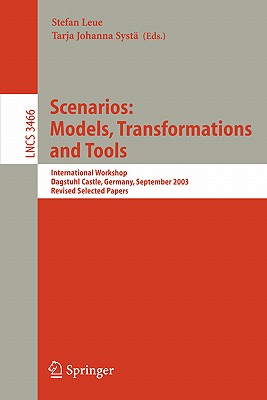
SCENARIOS MODELS TRANSFORMATIO
Paperback · ISBN 9783540261896
Inclusive of GST and other taxes
Arriving at your doorstep in 10-15 days
Our logisitcs team will make sure everyitem is delivered safely
| ISBN | 9783540261896 |
|---|---|
| Subtitle | SCENARIOS MODELS TRANSFORMATIO |
| Publisher | Springer |
| Publication date | June 2005 |
| Language | English |
| MRP | £44.99 GBP |
| Page count | 296 |
| Item weight | 92 g |
Visual notations and languages continue to play a pivotal role in the design of complex software systems. In many cases visual notations are used to - scribe usage or interaction scenarios of software systems or their components. While representing scenarios using a visual notation is not the only possibility, a vast majority of scenario description languages is visual. Scenarios are used in telecommunications as Message Sequence Charts, in object-oriented system design as Sequence Diagrams, in reverse engineering as execution traces, and in requirements engineering as, for example, Use Case Maps or Life Sequence Charts. These techniques are used to capture requirements, to capture use cases in system documentation, to specify test cases, or to visualize runs of existing systems. They are often employed to represent concurrent systems that int- act via message passing or method invocation. In telecommunications, for more than 15 years the International Telecommunication Union has standardized the Message Sequence Charts (MSCs) notation in its recommendation Z. 120. More recently, with the emergence of UML as a predominant software design meth- ology, there has been special interest in the development of the sequence d- gram notation. As a result, the most recent version, 2. 0, of UML encompasses the Message Sequence Chart notation, including its hierarchical modeling f- tures. Other scenario-?avored diagrams in UML 2. 0 include activity diagrams and timing diagrams.
Log in to write a review for this book.
No reviews yet. Be the first to share your opinion.
Biography not available.
Biography not available.