Danilov, Vladimir I. Author
Biography not available.

Browse all FOLKLORE books
Browse all GARDENS books
Browse all GRAPHIC NOVELS books
Browse all HISTORY - MEDIEVAL books
Browse all HUMOUR books
Browse all Juvenile Fiction : Biographical - Other books
Browse all Juvenile Fiction : Historical - Other books
Browse all Juvenile Fiction : Legends, Myths, & Fables - Other books
Browse all Juvenile Fiction : People & Places - Other books
Browse all Juvenile Fiction : People & Places - United States - Other books
Browse all Juvenile Fiction : Religious - Other books
Browse all Juvenile Nonfiction : History - Other books
Browse all Juvenile Nonfiction : Mathematics - Advanced books
Browse all Juvenile Nonfiction : People & Places - Other books
Browse all Juvenile Nonfiction : People & Places - United States - Othe books
Browse all LITERARY STUDIES books
Browse all LONDON books
Browse all Medical : Nursing - Mental Health books
Browse all MIND books
Browse all MUSEOLOGY books
Browse all NON-CLASSIFIABLE books
Browse all NONLINEAR SCIENCE books
Browse all POPULAR SCIENCE books
Browse all RELIGIOUS STUDIES books
Browse all SPIRIT books
Browse all SPORT books
Browse all TRAVEL WRITING books
 Out of Stock
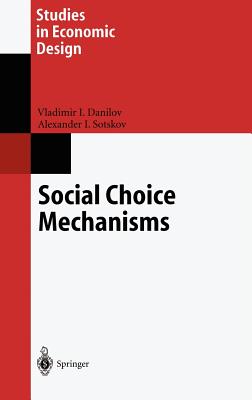
SOCIAL CHOICE MECHANISMS 2002/
Hardback · ISBN 9783540431053
Inclusive of GST and other taxes
Arriving at your doorstep in 10-15 days
Our logisitcs team will make sure everyitem is delivered safely
| ISBN | 9783540431053 |
|---|---|
| Subtitle | SOCIAL CHOICE MECHANISMS 2002/ |
| Publisher | Springer |
| Publication date | February 2002 |
| Language | English |
| MRP | £89.99 GBP |
| Page count | 204 |
| Item weight | 103 g |
The theory of social choice deals with both the processes and results of col- lective decision making. In this book, we explore some issues in the theory of social choice and mechanism design. We examine the premises of this theory, the axiomatic approach, and the mechanism design approach. The main questions are what is collective interest, how is it related to individuals' interests, how should one design social interactions, laws, and in- stitutions? These questions are not new. Philosophers, social scientists have indeed pondered upon them for years. And, in fact, the organizational struc- tures of many social institutions -courts, parliaments, committees and reg- ulatory boards -often lack a sound theoretical base. This is not surprising, as it is, indeed, difficult to provide for a comprehensive formalization of the activities of such organizations. Nevertheless, there has been a definite trend towards providing clear and unambiguous rules for collective decision mak- ing. These very rules constitute the body of social choice theory and its main object. The basic problem of social choice We explain here more precisely what a problem of social choice is, what approaches might be used to tackle it, and what kind of solutions it leads to. We introduce a few basic notions in preliminarily fashion and, in doing so, we stress both motivations and explanations.
Log in to write a review for this book.
No reviews yet. Be the first to share your opinion.
Biography not available.
Biography not available.