Destuynder, Philippe Author
Biography not available.

Browse all FOLKLORE books
Browse all GARDENS books
Browse all GRAPHIC NOVELS books
Browse all HISTORY - MEDIEVAL books
Browse all HUMOUR books
Browse all Juvenile Fiction : Biographical - Other books
Browse all Juvenile Fiction : Historical - Other books
Browse all Juvenile Fiction : Legends, Myths, & Fables - Other books
Browse all Juvenile Fiction : People & Places - Other books
Browse all Juvenile Fiction : People & Places - United States - Other books
Browse all Juvenile Fiction : Religious - Other books
Browse all Juvenile Nonfiction : History - Other books
Browse all Juvenile Nonfiction : Mathematics - Advanced books
Browse all Juvenile Nonfiction : People & Places - Other books
Browse all Juvenile Nonfiction : People & Places - United States - Othe books
Browse all LITERARY STUDIES books
Browse all LONDON books
Browse all Medical : Nursing - Mental Health books
Browse all MIND books
Browse all MUSEOLOGY books
Browse all NON-CLASSIFIABLE books
Browse all NONLINEAR SCIENCE books
Browse all POPULAR SCIENCE books
Browse all RELIGIOUS STUDIES books
Browse all SPIRIT books
Browse all SPORT books
Browse all TRAVEL WRITING books
 Out of Stock
MATHEMATICAL ANALYSIS OF THIN
Paperback · ISBN 9783540611677
Inclusive of GST and other taxes
Arriving at your doorstep in 10-15 days
Our logisitcs team will make sure everyitem is delivered safely
| ISBN | 9783540611677 |
|---|---|
| Subtitle | MATHEMATICAL ANALYSIS OF THIN |
| Publisher | Springer |
| Publication date | July 1996 |
| Language | English |
| MRP | £44.99 GBP |
| Page count | 252 |
| Item weight | 79 g |
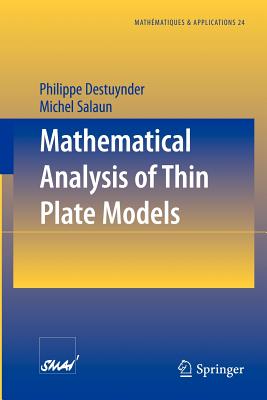
Shells and plates have been widely studied by engineers during the last fifty years. As a matter of fact an important number of papers have been based on analytical calculations. More recently numerical simulations have been extensively used. for instance for large displacement analysis. for shape optimization or even -in linear analysis -for composite material understanding. But all these works lie on a choice of a finite element scheme which contains usually three kinds of approximations: 1. a plate or shell mndel including smnll parameters associated to the thickness, 2. an approximntion of the geometry (the medium sUrface of a shell and its boundary), 3. afinite element scheme in order to solve the mndel chosen. VI Obviously the conclusions that we can draw are very much depending on the quality of the three previous choices. For instance composite laminated plates with damage like a delamination is still an open problem even if interesting papers have already been published and based on numerical simulation using existing fmite element and even plate models. - In our opinion the understanding of plate modelling is still an area of interest. Furthermore the links between the various models have to be handled with care. The certainly best understood model is the Kirchhoff-Love model which was completely justified by P. O. Ciarlet and Ph. Destuynder in linear analysis using asymptotic method. But the conclusion is not so clear as far as large displacements are to be taken into account.
Log in to write a review for this book.
No reviews yet. Be the first to share your opinion.
Biography not available.
Biography not available.