Linß, Torsten Author
Biography not available.

Browse all FOLKLORE books
Browse all GARDENS books
Browse all GRAPHIC NOVELS books
Browse all HISTORY - MEDIEVAL books
Browse all HUMOUR books
Browse all Juvenile Fiction : Biographical - Other books
Browse all Juvenile Fiction : Historical - Other books
Browse all Juvenile Fiction : Legends, Myths, & Fables - Other books
Browse all Juvenile Fiction : People & Places - Other books
Browse all Juvenile Fiction : People & Places - United States - Other books
Browse all Juvenile Fiction : Religious - Other books
Browse all Juvenile Nonfiction : History - Other books
Browse all Juvenile Nonfiction : Mathematics - Advanced books
Browse all Juvenile Nonfiction : People & Places - Other books
Browse all Juvenile Nonfiction : People & Places - United States - Othe books
Browse all LITERARY STUDIES books
Browse all LONDON books
Browse all Medical : Nursing - Mental Health books
Browse all MIND books
Browse all MUSEOLOGY books
Browse all NON-CLASSIFIABLE books
Browse all NONLINEAR SCIENCE books
Browse all POPULAR SCIENCE books
Browse all RELIGIOUS STUDIES books
Browse all SPIRIT books
Browse all SPORT books
Browse all TRAVEL WRITING books
 Out of Stock
LAYER-ADAPTED MESHES FOR REACT
Paperback · ISBN 9783642051333
Inclusive of GST and other taxes
Arriving at your doorstep in 10-15 days
Our logisitcs team will make sure everyitem is delivered safely
| ISBN | 9783642051333 |
|---|---|
| Subtitle | LAYER-ADAPTED MESHES FOR REACT |
| Publisher | Springer |
| Publication date | December 2009 |
| Language | English |
| MRP | £44.99 GBP |
| Page count | 340 |
| Item weight | 106 g |
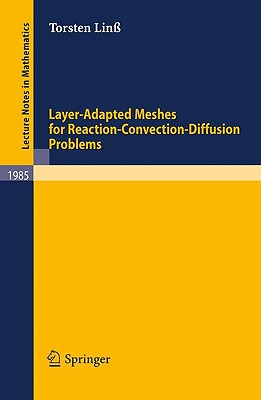
This is a book on numerical methods for singular perturbation problems - in part- ular, stationary reaction-convection-diffusion problems exhibiting layer behaviour. More precisely, it is devoted to the construction and analysis of layer-adapted meshes underlying these numerical methods. Numerical methods for singularly perturbed differential equations have been studied since the early 1970s and the research frontier has been constantly - panding since. A comprehensive exposition of the state of the art in the analysis of numerical methods for singular perturbation problems is [141] which was p- lished in 2008. As that monograph covers a big variety of numerical methods, it only contains a rather short introduction to layer-adapted meshes, while the present book is exclusively dedicated to that subject. An early important contribution towards the optimisation of numerical methods by means of special meshes was made by N.S. Bakhvalov [18] in 1969. His paper spawned a lively discussion in the literature with a number of further meshes - ing proposed and applied to various singular perturbation problems. However, in the mid 1980s, this development stalled, but was enlivened again by G.I. Shishkin's proposal of piecewise-equidistant meshes in the early 1990s [121,150]. Because of their very simple structure, they are often much easier to analyse than other meshes, although they give numerical approximations that are inferior to solutions on c- peting meshes. Shishkin meshes for numerous problems and numerical methods have been studied since and they are still very much in vogue.
Log in to write a review for this book.
No reviews yet. Be the first to share your opinion.
Biography not available.