Dijk, G.van Author
Biography not available.

Browse all FOLKLORE books
Browse all GARDENS books
Browse all GRAPHIC NOVELS books
Browse all HISTORY - MEDIEVAL books
Browse all HUMOUR books
Browse all Juvenile Fiction : Biographical - Other books
Browse all Juvenile Fiction : Historical - Other books
Browse all Juvenile Fiction : Legends, Myths, & Fables - Other books
Browse all Juvenile Fiction : People & Places - Other books
Browse all Juvenile Fiction : People & Places - United States - Other books
Browse all Juvenile Fiction : Religious - Other books
Browse all Juvenile Nonfiction : History - Other books
Browse all Juvenile Nonfiction : Mathematics - Advanced books
Browse all Juvenile Nonfiction : People & Places - Other books
Browse all Juvenile Nonfiction : People & Places - United States - Othe books
Browse all LITERARY STUDIES books
Browse all LONDON books
Browse all Medical : Nursing - Mental Health books
Browse all MIND books
Browse all MUSEOLOGY books
Browse all NON-CLASSIFIABLE books
Browse all NONLINEAR SCIENCE books
Browse all POPULAR SCIENCE books
Browse all RELIGIOUS STUDIES books
Browse all SPIRIT books
Browse all SPORT books
Browse all TRAVEL WRITING books
 Out of Stock
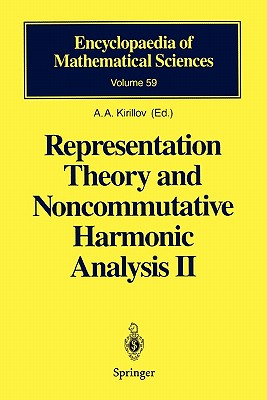
REPRESENTATION THEORY & NONCOM
Paperback · ISBN 9783642081262
Inclusive of GST and other taxes
Arriving at your doorstep in 10-15 days
Our logisitcs team will make sure everyitem is delivered safely
| ISBN | 9783642081262 |
|---|---|
| Subtitle | REPRESENTATION THEORY & NONCOM |
| Publisher | Springer |
| Publication date | December 2010 |
| Language | English |
| MRP | £89.99 GBP |
| Page count | 280 |
| Item weight | 88 g |
At first only elementary functions were studied in mathematical analysis. Then new functions were introduced to evaluate integrals. They were named special functions: integral sine, logarithms, the exponential function, the prob- ability integral and so on. Elliptic integrals proved to be the most important. They are connected with rectification of arcs of certain curves. The remarkable idea of Abel to replace these integrals by the corresponding inverse functions led to the creation of the theory of elliptic functions. They are doubly periodic functions of a complex variable. This periodicity has led to consideration of the lattice of periods and to linear-fractional trans- formations of the complex plane which leave this lattice invariant. The group of these transformations is isomorphic to the quotient group of the group 8L(2, Z) of unimodular matrices of the second order with integral elements with respect to its center. Investigation of properties of elliptic functions led to the study of automorphic functions and forms. This gave the first connec- tion between the theory of groups and this important class of functions. The further development of the theory of automorphic functions was related to geometric concepts connected with the fact that the group of linear-fractional transformations with real elements can be realized as the group of motions of th the Lobachevskij plane. We also note that at the beginning of the 19 century Gauss used the group 8L(2, Z) in his papers on the theory of indeterminate quadratic forms.
Log in to write a review for this book.
No reviews yet. Be the first to share your opinion.
Biography not available.
Biography not available.
Biography not available.