Gutiérrez, Agustín|Marco, Santiago Editor
Biography not available.

Browse all FOLKLORE books
Browse all GARDENS books
Browse all GRAPHIC NOVELS books
Browse all HISTORY - MEDIEVAL books
Browse all HUMOUR books
Browse all Juvenile Fiction : Biographical - Other books
Browse all Juvenile Fiction : Historical - Other books
Browse all Juvenile Fiction : Legends, Myths, & Fables - Other books
Browse all Juvenile Fiction : People & Places - Other books
Browse all Juvenile Fiction : People & Places - United States - Other books
Browse all Juvenile Fiction : Religious - Other books
Browse all Juvenile Nonfiction : History - Other books
Browse all Juvenile Nonfiction : Mathematics - Advanced books
Browse all Juvenile Nonfiction : People & Places - Other books
Browse all Juvenile Nonfiction : People & Places - United States - Othe books
Browse all LITERARY STUDIES books
Browse all LONDON books
Browse all Medical : Nursing - Mental Health books
Browse all MIND books
Browse all MUSEOLOGY books
Browse all NON-CLASSIFIABLE books
Browse all NONLINEAR SCIENCE books
Browse all POPULAR SCIENCE books
Browse all RELIGIOUS STUDIES books
Browse all SPIRIT books
Browse all SPORT books
Browse all TRAVEL WRITING books
 Out of Stock
BIOLOGICALLY INSPIRED SIGNAL P
Paperback · ISBN 9783642101212
Inclusive of GST and other taxes
Arriving at your doorstep in 10-15 days
Our logisitcs team will make sure everyitem is delivered safely
| ISBN | 9783642101212 |
|---|---|
| Subtitle | BIOLOGICALLY INSPIRED SIGNAL P |
| Publisher | Springer |
| Publication date | October 2010 |
| Language | English |
| MRP | £109.99 GBP |
| Page count | 184 |
| Item weight | 59 g |
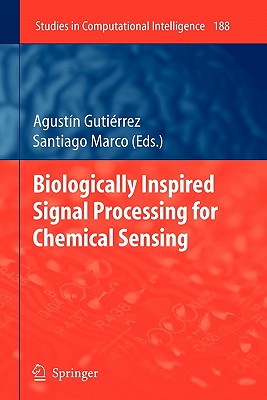
Biologically inspired approaches for artificial sensing have been extensively applied to different sensory modalities over the last decades and chemical senses have been no exception. The olfactory system, and the gustatory system to a minor extent, has been regarded as a model for the development of new artificial chemical sensing s- tems. One of the main contributions to this field was done by Persaud and Dodd in 1982 when they proposed a system based on an array of broad-selective chemical sensors coupled with a pattern recognition engine. The array aimed at mimicking the sensing strategy followed by the olfactory system where a population of bro- selective olfactory receptor neurons encodes for chemical information as patterns of activity across the neuron population. The pattern recognition engine proposed was not based on bio-inspired but on statistical methods. This influential work gave rise to a new line of research where this paradigm has been used to build chemical sensing instruments applied to a wide range of odor detection problems. More recently, some researchers have proposed to extend the biological inspiration of this system also to the processing of the sensor array signals. This has been mo- vated in part by the increasing body of knowledge available on biological olfaction, which has become in the last decade a focus of attention of the experimental neu- science community.
Log in to write a review for this book.
No reviews yet. Be the first to share your opinion.
Biography not available.