Sturm, Jürgen Author
Biography not available.

Browse all FOLKLORE books
Browse all GARDENS books
Browse all GRAPHIC NOVELS books
Browse all HISTORY - MEDIEVAL books
Browse all HUMOUR books
Browse all Juvenile Fiction : Biographical - Other books
Browse all Juvenile Fiction : Historical - Other books
Browse all Juvenile Fiction : Legends, Myths, & Fables - Other books
Browse all Juvenile Fiction : People & Places - Other books
Browse all Juvenile Fiction : People & Places - United States - Other books
Browse all Juvenile Fiction : Religious - Other books
Browse all Juvenile Nonfiction : History - Other books
Browse all Juvenile Nonfiction : Mathematics - Advanced books
Browse all Juvenile Nonfiction : People & Places - Other books
Browse all Juvenile Nonfiction : People & Places - United States - Othe books
Browse all LITERARY STUDIES books
Browse all LONDON books
Browse all Medical : Nursing - Mental Health books
Browse all MIND books
Browse all MUSEOLOGY books
Browse all NON-CLASSIFIABLE books
Browse all NONLINEAR SCIENCE books
Browse all POPULAR SCIENCE books
Browse all RELIGIOUS STUDIES books
Browse all SPIRIT books
Browse all SPORT books
Browse all TRAVEL WRITING books
 Out of Stock
APPROACHES TO PROBABILISTIC MO
Hardback · ISBN 9783642371592
Inclusive of GST and other taxes
Arriving at your doorstep in 10-15 days
Our logisitcs team will make sure everyitem is delivered safely
| ISBN | 9783642371592 |
|---|---|
| Subtitle | APPROACHES TO PROBABILISTIC MO |
| Publisher | Springer |
| Publication date | May 2013 |
| Language | English |
| MRP | £89.99 GBP |
| Page count | 232 |
| Item weight | 111 g |
Mobile manipulation robots are envisioned to provide many useful services both in domestic environments as well as in the industrial context.
Examples include domestic service robots that implement large parts of the housework, and versatile industrial assistants that provide automation, transportation, inspection, and monitoring services. The challenge in these applications is that the robots have to function under changing, real-world conditions, be able to deal with considerable amounts of noise and uncertainty, and operate without the supervision of an expert.
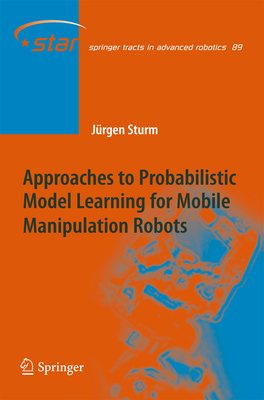
This book presents novel learning techniques that enable mobile manipulation robots, i.e., mobile platforms with one or more robotic manipulators, to autonomously adapt to new or changing situations. The approaches presented in this book cover the following topics: (1) learning the robot's kinematic structure and properties using actuation and visual feedback, (2) learning about articulated objects in the environment in which the robot is operating, (3) using tactile feedback to augment the visual perception, and (4) learning novel manipulation tasks from human demonstrations.
This book is an ideal resource for postgraduates and researchers working in robotics, computer vision, and artificial intelligence who want to get an overview on one of the following subjects:
- kinematic modeling and learning,
- self-calibration and life-long adaptation,
- tactile sensing and tactile object recognition, and
- imitation learning and programming by demonstration.
Log in to write a review for this book.
No reviews yet. Be the first to share your opinion.
Biography not available.