Astesiano, Egidio Editor
Biography not available.

Browse all FOLKLORE books
Browse all GARDENS books
Browse all GRAPHIC NOVELS books
Browse all HISTORY - MEDIEVAL books
Browse all HUMOUR books
Browse all Juvenile Fiction : Biographical - Other books
Browse all Juvenile Fiction : Historical - Other books
Browse all Juvenile Fiction : Legends, Myths, & Fables - Other books
Browse all Juvenile Fiction : People & Places - Other books
Browse all Juvenile Fiction : People & Places - United States - Other books
Browse all Juvenile Fiction : Religious - Other books
Browse all Juvenile Nonfiction : History - Other books
Browse all Juvenile Nonfiction : Mathematics - Advanced books
Browse all Juvenile Nonfiction : People & Places - Other books
Browse all Juvenile Nonfiction : People & Places - United States - Othe books
Browse all LITERARY STUDIES books
Browse all LONDON books
Browse all Medical : Nursing - Mental Health books
Browse all MIND books
Browse all MUSEOLOGY books
Browse all NON-CLASSIFIABLE books
Browse all NONLINEAR SCIENCE books
Browse all POPULAR SCIENCE books
Browse all RELIGIOUS STUDIES books
Browse all SPIRIT books
Browse all SPORT books
Browse all TRAVEL WRITING books
 Out of Stock
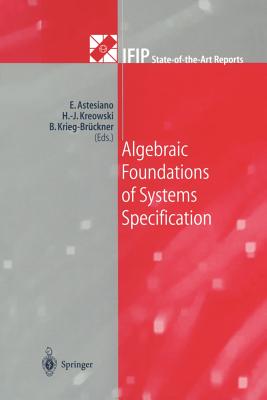
ALGEBRAIC FOUNDATIONS OF SYSTE
Paperback · ISBN 9783642641510
Inclusive of GST and other taxes
Arriving at your doorstep in 10-15 days
Our logisitcs team will make sure everyitem is delivered safely
| ISBN | 9783642641510 |
|---|---|
| Subtitle | ALGEBRAIC FOUNDATIONS OF SYSTE |
| Publisher | Springer |
| Publication date | October 2011 |
| Language | English |
| MRP | £44.99 GBP |
| Page count | 632 |
| Item weight | 193 g |
The aim of software engineering is the provision and investigation of methods for the development of software systems of high quality with correctness as a key issue. A system is called correct if it does what one wants, if it meets the requirements. To achieve and to guarantee correct systems, the need of formal methods with rigorous semantics and the possibility of verification is widely accepted. Algebraic specification is a software engineering approach of this perspective. When Liskov and Zilles, Guttag and the ADJ-group with Goguen, Thatch- er, Wagner and Wright introduced the basic ideas of algebraic specification in the mid seventies in the U. S. A. and Canada, they initiated a very successful and still flourishing new area. In the late seventies, algebraic specification became a major research topic also in many European countries. Originally, the algebraic framework was intended for the mathematical foundation of ab- stract data types and the formal development of first-order applicative pro- grams. Meanwhile, the range of applications has been extended to the precise specification of complete software systems, the uniform definition of syntax and semantics of programming languages, and to the stepwise development of correct systems from the requirement definitions to the running programs. The activities in the last 25 years have led to an abundance of concepts, methods, approaches, theories, languages and tools, which are mathemati- cally founded in universal algebra, category theory and logic.
Log in to write a review for this book.
No reviews yet. Be the first to share your opinion.
Biography not available.
Biography not available.
Biography not available.