van den Berg, C. Author
Biography not available.

Browse all FOLKLORE books
Browse all GARDENS books
Browse all GRAPHIC NOVELS books
Browse all HISTORY - MEDIEVAL books
Browse all HUMOUR books
Browse all Juvenile Fiction : Biographical - Other books
Browse all Juvenile Fiction : Historical - Other books
Browse all Juvenile Fiction : Legends, Myths, & Fables - Other books
Browse all Juvenile Fiction : People & Places - Other books
Browse all Juvenile Fiction : People & Places - United States - Other books
Browse all Juvenile Fiction : Religious - Other books
Browse all Juvenile Nonfiction : History - Other books
Browse all Juvenile Nonfiction : Mathematics - Advanced books
Browse all Juvenile Nonfiction : People & Places - Other books
Browse all Juvenile Nonfiction : People & Places - United States - Othe books
Browse all LITERARY STUDIES books
Browse all LONDON books
Browse all Medical : Nursing - Mental Health books
Browse all MIND books
Browse all MUSEOLOGY books
Browse all NON-CLASSIFIABLE books
Browse all NONLINEAR SCIENCE books
Browse all POPULAR SCIENCE books
Browse all RELIGIOUS STUDIES books
Browse all SPIRIT books
Browse all SPORT books
Browse all TRAVEL WRITING books
 Out of Stock
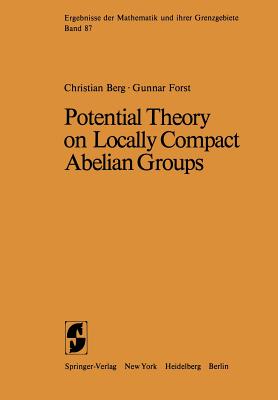
POTENTIAL THEORY ON LOCALLY CO
Paperback · ISBN 9783642661303
Inclusive of GST and other taxes
Arriving at your doorstep in 10-15 days
Our logisitcs team will make sure everyitem is delivered safely
| ISBN | 9783642661303 |
|---|---|
| Subtitle | POTENTIAL THEORY ON LOCALLY CO |
| Publisher | Springer |
| Publication date | November 2011 |
| Language | English |
| MRP | £44.99 GBP |
| Page count | 212 |
| Item weight | 77 g |
Classical potential theory can be roughly characterized as the study of Newtonian potentials and the Laplace operator on the Euclidean space JR3. It was discovered around 1930 that there is a profound connection between classical potential 3 theory and the theory of Brownian motion in JR . The Brownian motion is determined by its semigroup of transition probabilities, the Brownian semigroup, and the connection between classical potential theory and the theory of Brownian motion can be described analytically in the following way: The Laplace operator is the infinitesimal generator for the Brownian semigroup and the Newtonian potential kernel is the" integral" of the Brownian semigroup with respect to time. This connection between classical potential theory and the theory of Brownian motion led Hunt (cf. Hunt [2]) to consider general "potential theories" defined in terms of certain stochastic processes or equivalently in terms of certain semi- groups of operators on spaces of functions. The purpose of the present exposition is to study such general potential theories where the following aspects of classical potential theory are preserved: (i) The theory is defined on a locally compact abelian group. (ii) The theory is translation invariant in the sense that any translate of a potential or a harmonic function is again a potential, respectively a harmonic function; this property of classical potential theory can also be expressed by saying that the Laplace operator is a differential operator with constant co- efficients.
Log in to write a review for this book.
No reviews yet. Be the first to share your opinion.
Biography not available.
Biography not available.