Anonymous Author
Biography not available.

Browse all FOLKLORE books
Browse all GARDENS books
Browse all GRAPHIC NOVELS books
Browse all HISTORY - MEDIEVAL books
Browse all HUMOUR books
Browse all Juvenile Fiction : Biographical - Other books
Browse all Juvenile Fiction : Historical - Other books
Browse all Juvenile Fiction : Legends, Myths, & Fables - Other books
Browse all Juvenile Fiction : People & Places - Other books
Browse all Juvenile Fiction : People & Places - United States - Other books
Browse all Juvenile Fiction : Religious - Other books
Browse all Juvenile Nonfiction : History - Other books
Browse all Juvenile Nonfiction : Mathematics - Advanced books
Browse all Juvenile Nonfiction : People & Places - Other books
Browse all Juvenile Nonfiction : People & Places - United States - Othe books
Browse all LITERARY STUDIES books
Browse all LONDON books
Browse all Medical : Nursing - Mental Health books
Browse all MIND books
Browse all MUSEOLOGY books
Browse all NON-CLASSIFIABLE books
Browse all NONLINEAR SCIENCE books
Browse all POPULAR SCIENCE books
Browse all RELIGIOUS STUDIES books
Browse all SPIRIT books
Browse all SPORT books
Browse all TRAVEL WRITING books
 Out of Stock
Paperback · ISBN 9783668341463
Inclusive of GST and other taxes
Arriving at your doorstep in 10-15 days
Our logisitcs team will make sure everyitem is delivered safely
| ISBN | 9783668341463 |
|---|---|
| Publisher | GRIN Verlag |
| Publication date | November 2016 |
| Language | English |
| MRP | £18.90 GBP |
| Page count | 20 |
| Item weight | 9 g |
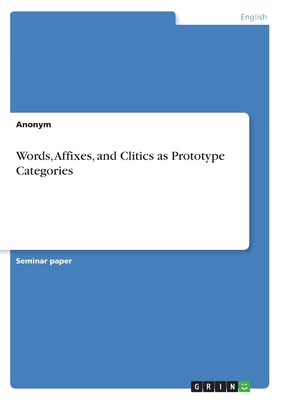
Seminar paper from the year 2015 in the subject English Language and Literature Studies - Linguistics, grade: 1,3, University of Cologne (Englisches Seminar I), course: Linguistic Categorization, language: English, abstract: The purpose of this paper is to provide some evidence for the existence of prototype categories in grammar, and to demonstrate that prototypicality does apply to this level of language. To complete this task, three grammatical categories, namely words, affixes, and clitics will be closely examined and analysed. First, it will be attempted to define these categories as well as to suggest the criteria for category membership. Then, these categories will be compared and contrasted, and it is not until this comparison that their prototypical nature can reveal itself and becomes evident. It is hard to find a discipline which would not be concerned with the notions of category and categorisation in some ways. These issues are of particular interest for psychology, philosophy, and linguistics. These sciences treat these subjects differently, but for all of them they have long been a major focus of a number of their investigations. The notion of category is closely connected with the name of the Greek philosopher Aristotle. His conceptualisation of category, being defined in terms of necessary and sufficient criteria, which has clear-cut boundaries and members with an equal membership status, has been valid and relevant for the most part of the 20th century. The emergence of cognitive science in 1970 made it necessary to reassess the Aristotelian definition of category. Plenty of research held at that time showed that not all categories conformed to the classical theory of categorisation, but that there are also those with a prototype structure. The boundaries of these categories are not clear but fuzzy, and their members do not all have an equal status.
Log in to write a review for this book.
No reviews yet. Be the first to share your opinion.
Biography not available.