Vineis, Claudia Author
Biography not available.

Browse all FOLKLORE books
Browse all GARDENS books
Browse all GRAPHIC NOVELS books
Browse all HISTORY - MEDIEVAL books
Browse all HUMOUR books
Browse all Juvenile Fiction : Biographical - Other books
Browse all Juvenile Fiction : Historical - Other books
Browse all Juvenile Fiction : Legends, Myths, & Fables - Other books
Browse all Juvenile Fiction : People & Places - Other books
Browse all Juvenile Fiction : People & Places - United States - Other books
Browse all Juvenile Fiction : Religious - Other books
Browse all Juvenile Nonfiction : History - Other books
Browse all Juvenile Nonfiction : Mathematics - Advanced books
Browse all Juvenile Nonfiction : People & Places - Other books
Browse all Juvenile Nonfiction : People & Places - United States - Othe books
Browse all LITERARY STUDIES books
Browse all LONDON books
Browse all Medical : Nursing - Mental Health books
Browse all MIND books
Browse all MUSEOLOGY books
Browse all NON-CLASSIFIABLE books
Browse all NONLINEAR SCIENCE books
Browse all POPULAR SCIENCE books
Browse all RELIGIOUS STUDIES books
Browse all SPIRIT books
Browse all SPORT books
Browse all TRAVEL WRITING books
 Out of Stock
Hardback · ISBN 9783725841776
Inclusive of GST and other taxes
Arriving at your doorstep in 10-15 days
Our logisitcs team will make sure everyitem is delivered safely
| ISBN | 9783725841776 |
|---|---|
| Publisher | MDPI AG |
| Publication date | June 2025 |
| Language | English |
| MRP | £76.67 GBP |
| Page count | 274 |
| Item weight | 179 g |
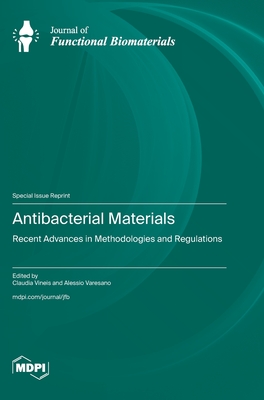
In recent years, the emergence of resistant bacteria has stimulated intensive research in developing antibacterial materials in different fields in order to reduce the spread of antibiotic-resistant bacterial strains. Novel antibacterial materials include a large number of compounds such as nanoparticles, polymers, chemicals, proteins, and enzymes. Moreover, the final antibacterial products that embed the antibacterial compound can have many different shapes, such as textiles, plastics, cosmetics, ceramics, metals, paper, wood, etc. It is difficult to compare the performances of such different materials and applications because cross-method comparisons are currently lacking in the literature. Moreover, the procedures for testing developed in the past are often unsuitable for new antibacterial materials/products, and the scientific soundness of the results can be weak. Quantification (e.g., bacterial reduction) is crucial, and qualitative-only methods can be misleading. The conditions for testing required by current regulations should be critically evaluated to assess the limits of their applications. On the other hand, existing procedures for antibacterial testing of materials are usually quite far from real conditions. Simple and affordable methods have to be developed in order to ensure reproducibility and robustness in conditions close to real world. The aim of this Special Issue is to stimulate contributions to fill these gaps.
Log in to write a review for this book.
No reviews yet. Be the first to share your opinion.
Biography not available.
Biography not available.