Monari, Paola Editor
Biography not available.

Browse all FOLKLORE books
Browse all GARDENS books
Browse all GRAPHIC NOVELS books
Browse all HISTORY - MEDIEVAL books
Browse all HUMOUR books
Browse all Juvenile Fiction : Biographical - Other books
Browse all Juvenile Fiction : Historical - Other books
Browse all Juvenile Fiction : Legends, Myths, & Fables - Other books
Browse all Juvenile Fiction : People & Places - Other books
Browse all Juvenile Fiction : People & Places - United States - Other books
Browse all Juvenile Fiction : Religious - Other books
Browse all Juvenile Nonfiction : History - Other books
Browse all Juvenile Nonfiction : Mathematics - Advanced books
Browse all Juvenile Nonfiction : People & Places - Other books
Browse all Juvenile Nonfiction : People & Places - United States - Othe books
Browse all LITERARY STUDIES books
Browse all LONDON books
Browse all Medical : Nursing - Mental Health books
Browse all MIND books
Browse all MUSEOLOGY books
Browse all NON-CLASSIFIABLE books
Browse all NONLINEAR SCIENCE books
Browse all POPULAR SCIENCE books
Browse all RELIGIOUS STUDIES books
Browse all SPIRIT books
Browse all SPORT books
Browse all TRAVEL WRITING books
 Out of Stock
STATISTICAL METHODS FOR THE EV
Paperback · ISBN 9783790828122
Inclusive of GST and other taxes
Arriving at your doorstep in 10-15 days
Our logisitcs team will make sure everyitem is delivered safely
| ISBN | 9783790828122 |
|---|---|
| Subtitle | STATISTICAL METHODS FOR THE EV |
| Publisher | Physica |
| Publication date | March 2012 |
| Language | English |
| MRP | £179.99 GBP |
| Page count | 260 |
| Item weight | 82 g |
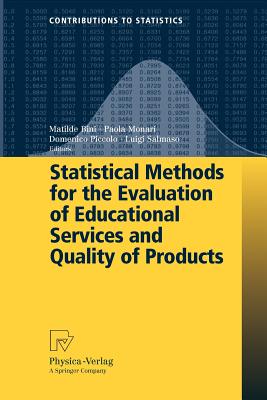
The book presents statistical methods and models that can usefully support the ev- uation of educational services and quality of products. The contributions collected in this book summarize the work of several researchers from the universities of Bologna, Firenze, Napoli and Padova. The contributions are written with a cons- tent notation and a uni?ed view, and concern methodological advances developed mostly with reference to speci?c problems of evaluation using real data sets. The evaluation of educational services, as well as the analysis of judgements and preferences, poses severe methodological challenges because of the presence of one or more of the following aspects: the observational (non experimental) nature of the context, which is associated with the well-known problems of selection bias and presence of nuisance factors; the hierarchical structure of the data, that entails c- related observations and consideration of effects at different levels of the hierarchy and their interactions (multilevel analysis); the multivariate and qualitative nature of the dependent variable, that requires the use of ad hoc statistical methodologies; the presence of non observable factors, e. g. the satisfaction, calling for the use of latent variables models; the simultaneous presence of components of pleasure and components of uncertainty in the explication of the judgments, that asks for the speci?cation and estimation of mixture models. The ?rst part of the book deals with latent variable models.
Log in to write a review for this book.
No reviews yet. Be the first to share your opinion.
Biography not available.
Biography not available.
Biography not available.