Harchaoui, Sarah Editor
Biography not available.

Browse all FOLKLORE books
Browse all GARDENS books
Browse all GRAPHIC NOVELS books
Browse all HISTORY - MEDIEVAL books
Browse all HUMOUR books
Browse all Juvenile Fiction : Biographical - Other books
Browse all Juvenile Fiction : Historical - Other books
Browse all Juvenile Fiction : Legends, Myths, & Fables - Other books
Browse all Juvenile Fiction : People & Places - Other books
Browse all Juvenile Fiction : People & Places - United States - Other books
Browse all Juvenile Fiction : Religious - Other books
Browse all Juvenile Nonfiction : History - Other books
Browse all Juvenile Nonfiction : Mathematics - Advanced books
Browse all Juvenile Nonfiction : People & Places - Other books
Browse all Juvenile Nonfiction : People & Places - United States - Othe books
Browse all LITERARY STUDIES books
Browse all LONDON books
Browse all Medical : Nursing - Mental Health books
Browse all MIND books
Browse all MUSEOLOGY books
Browse all NON-CLASSIFIABLE books
Browse all NONLINEAR SCIENCE books
Browse all POPULAR SCIENCE books
Browse all RELIGIOUS STUDIES books
Browse all SPIRIT books
Browse all SPORT books
Browse all TRAVEL WRITING books
 Out of Stock
Hardback · ISBN 9783985541553
Inclusive of GST and other taxes
Arriving at your doorstep in 10-15 days
Our logisitcs team will make sure everyitem is delivered safely
| ISBN | 9783985541553 |
|---|---|
| Publisher | Language Science Press |
| Publication date | September 2025 |
| Language | English |
| MRP | £40.00 GBP |
| Page count | 356 |
| Item weight | 169 g |
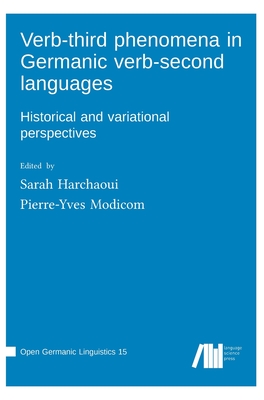
With the exception of English and its varieties, all Present-Day Germanic languages display some kind of verb-second (V2) rule, according to which the finite verbal form has to be put in the second position of the clause in declarative utterances. But even within the Germanic domain, the exact contours of the V2 rule vary strongly in time and space. Above all, the so-called bottleneck demanding that one and only one constituent be placed before the finite verb is not equally respected in all Germanic varieties. The typology of V2 violations, apparent or real, is now regarded as a core question for the typology of V2 itself. The present volume is concerned with all kinds of alleged "cracks in the bottleneck", involving argument stacking, remnant movement, or adverbial resumption. A general introduction by Modicom and Harchaoui discusses the current state of linguistic research on verb-third phenomena in Germanic languages, both in synchrony and diachrony. The introduction is followed by a diachronic panorama of V3 phenomena in the history of High German, by A. Speyer, who shows that behind the apparent stability of V2, the syntactic typology of apparent V3 in German has undergone significant changes over the last centuries. The other contributions to the volume follow this variational and historical thread: E. Klaevik-Pettersen and N. Catasso discuss the validity of the bottleneck hypothesis in present and ancient V2 varieties. E. Louviot, Th. Robin, Chr. Nilsen and B. Bloom focus on verb-third phenomena involving resumptive items in the history of English, High German, Low German and Swedish. In their paper on Old West Germanic verse corpora, Louviot and Robin concentrate on clause-initial tha/tho, investigating which factors determine its capacity to either be followed by the finite verb (V2) or by another constituent before the finite verb (V3). Nilsen is concerned with the semantic evolution of verb-third adverbial resumption involving da and så in Swedish. Bloom
Log in to write a review for this book.
No reviews yet. Be the first to share your opinion.
Biography not available.
Biography not available.