Maiti, Pradita Author
Biography not available.

Browse all FOLKLORE books
Browse all GARDENS books
Browse all GRAPHIC NOVELS books
Browse all HISTORY - MEDIEVAL books
Browse all HUMOUR books
Browse all Juvenile Fiction : Biographical - Other books
Browse all Juvenile Fiction : Historical - Other books
Browse all Juvenile Fiction : Legends, Myths, & Fables - Other books
Browse all Juvenile Fiction : People & Places - Other books
Browse all Juvenile Fiction : People & Places - United States - Other books
Browse all Juvenile Fiction : Religious - Other books
Browse all Juvenile Nonfiction : History - Other books
Browse all Juvenile Nonfiction : Mathematics - Advanced books
Browse all Juvenile Nonfiction : People & Places - Other books
Browse all Juvenile Nonfiction : People & Places - United States - Othe books
Browse all LITERARY STUDIES books
Browse all LONDON books
Browse all Medical : Nursing - Mental Health books
Browse all MIND books
Browse all MUSEOLOGY books
Browse all NON-CLASSIFIABLE books
Browse all NONLINEAR SCIENCE books
Browse all POPULAR SCIENCE books
Browse all RELIGIOUS STUDIES books
Browse all SPIRIT books
Browse all SPORT books
Browse all TRAVEL WRITING books
 Out of Stock
Paperback · ISBN 9786208421434
Inclusive of GST and other taxes
Arriving at your doorstep in 10-15 days
Our logisitcs team will make sure everyitem is delivered safely
| ISBN | 9786208421434 |
|---|---|
| Publisher | LAP Lambert Academic Publishing |
| Publication date | February 2025 |
| Language | English |
| MRP | £51.00 GBP |
| Page count | 120 |
| Item weight | 38 g |
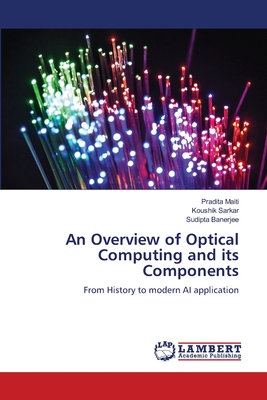
"An Overview of Optical Computing and its Components" offers an in-depth introduction to the developing field of optical computing, which leverages light instead of traditional electronic signals for computations. The book examines the fundamental concepts behind optical computing, emphasizing how the distinctive characteristics of light-such as speed, parallel processing capabilities, and energy efficiency-can address the limitations of conventional electronic computing systems. It explores the key components that are essential to optical computing systems, including optical fibers, waveguides, optical modulators, photodetectors, beam splitters, combiners, nonlinear optical materials, and integrated photonics. The book illustrates how each of these elements plays a crucial role in the operation of optical computers, facilitating faster data processing and lower energy consumption compared to electronic systems. Additionally, the book covers the practical uses of optical computing in fields such as artificial intelligence, machine learning, and high-performance computing, highlighting its potential to transform industries by efficiently managing large-scale, data-heavy tasks.
Log in to write a review for this book.
No reviews yet. Be the first to share your opinion.
Biography not available.
Biography not available.
Biography not available.