CHAVAN, SANDEEP Author
Biography not available.

Browse all FOLKLORE books
Browse all GARDENS books
Browse all GRAPHIC NOVELS books
Browse all HISTORY - MEDIEVAL books
Browse all HUMOUR books
Browse all Juvenile Fiction : Biographical - Other books
Browse all Juvenile Fiction : Historical - Other books
Browse all Juvenile Fiction : Legends, Myths, & Fables - Other books
Browse all Juvenile Fiction : People & Places - Other books
Browse all Juvenile Fiction : People & Places - United States - Other books
Browse all Juvenile Fiction : Religious - Other books
Browse all Juvenile Nonfiction : History - Other books
Browse all Juvenile Nonfiction : Mathematics - Advanced books
Browse all Juvenile Nonfiction : People & Places - Other books
Browse all Juvenile Nonfiction : People & Places - United States - Othe books
Browse all LITERARY STUDIES books
Browse all LONDON books
Browse all Medical : Nursing - Mental Health books
Browse all MIND books
Browse all MUSEOLOGY books
Browse all NON-CLASSIFIABLE books
Browse all NONLINEAR SCIENCE books
Browse all POPULAR SCIENCE books
Browse all RELIGIOUS STUDIES books
Browse all SPIRIT books
Browse all SPORT books
Browse all TRAVEL WRITING books
 Out of Stock
Paperback · ISBN 9788199541405
Inclusive of GST and other taxes
Arriving at your doorstep in 10-15 days
Our logisitcs team will make sure everyitem is delivered safely
| ISBN | 9788199541405 |
|---|---|
| Publisher | Gyrus Vision |
| Publication date | December 2025 |
| Language | English |
| MRP | £37.99 GBP |
| Page count | 316 |
| Item weight | 81 g |
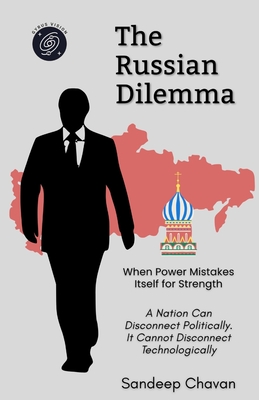
The Russian Dilemma is a gripping exploration of how sovereignty has shifted from borders to bandwidth, from territory to architecture, and from military might to compute power. Sandeep Chavan delivers a contrarian narrative that reframes Russia's collapse not as a failure of politics, but as a failure of technological integration.
Armed with vast landmass, abundant resources, and military strength, Russia believed it could disconnect politically while remaining relevant technologically. It was wrong. The twenty-first century does not reward isolation-it rewards intelligent interdependence. Sovereignty today is defined not by what a nation declares, but by what its technological backbone can sustain.
Through vivid storytelling and systems thinking, Chavan traces Russia's slow erosion: outdated semiconductor fabs, fragile cloud infrastructure, talent flight, ecosystem decay, and strategic miscalculations in the age of AI. Sanctions did not break Russia; they exposed its dependence on architectures it did not control.
But this book is not only about Russia. It is a mirror held up to every nation navigating the new technological order. China, despite scale and ambition, fears the same architectural trap. Europe thrives in talent but struggles in deep compute. The Middle East learns that wealth cannot buy time or ecosystem depth. India stands at a crossroads between opportunity and inertia. America's allies confront the uncomfortable truth that their sovereignty is inseparable from the very stack they critique.
Chavan introduces original frameworks-Architectural Sovereignty, Integration Sovereignty, and the Sovereignty Equation-to decode the new law of power. He argues that nations must stop defending only what they own and start defending where they are positioned in the global architecture. Compute, talent, and networks are the coal, oil, and steel of the digital era combined.
The Russian Dilemma is both analysis and field guide. It reveals why political sovereignty can no longer guarantee national strength, why isolation has become a penalty, and why integration is the only multiplier left in a world that has run out of time.
For leaders, thinkers, and citizens, this book offers a survival doctrine: build domestic cores that cannot be taken away, integrate where acceleration is cheaper than reinvention, adopt selective dependence as philosophy, and recognize that sovereignty now means position, not separation.
The verdict is clear: A nation can walk out of politics. It cannot walk out of compute.
Log in to write a review for this book.
No reviews yet. Be the first to share your opinion.
Biography not available.