Dowty, D. R. Author
Biography not available.

Browse all FOLKLORE books
Browse all GARDENS books
Browse all GRAPHIC NOVELS books
Browse all HISTORY - MEDIEVAL books
Browse all HUMOUR books
Browse all Juvenile Fiction : Biographical - Other books
Browse all Juvenile Fiction : Historical - Other books
Browse all Juvenile Fiction : Legends, Myths, & Fables - Other books
Browse all Juvenile Fiction : People & Places - Other books
Browse all Juvenile Fiction : People & Places - United States - Other books
Browse all Juvenile Fiction : Religious - Other books
Browse all Juvenile Nonfiction : History - Other books
Browse all Juvenile Nonfiction : Mathematics - Advanced books
Browse all Juvenile Nonfiction : People & Places - Other books
Browse all Juvenile Nonfiction : People & Places - United States - Othe books
Browse all LITERARY STUDIES books
Browse all LONDON books
Browse all Medical : Nursing - Mental Health books
Browse all MIND books
Browse all MUSEOLOGY books
Browse all NON-CLASSIFIABLE books
Browse all NONLINEAR SCIENCE books
Browse all POPULAR SCIENCE books
Browse all RELIGIOUS STUDIES books
Browse all SPIRIT books
Browse all SPORT books
Browse all TRAVEL WRITING books
 Out of Stock
INTRO TO MONTAGUE SEMANTICS 19
Hardback · ISBN 9789027711410
Inclusive of GST and other taxes
Arriving at your doorstep in 10-15 days
Our logisitcs team will make sure everyitem is delivered safely
| ISBN | 9789027711410 |
|---|---|
| Subtitle | INTRO TO MONTAGUE SEMANTICS 19 |
| Publisher | Springer |
| Publication date | December 1980 |
| Language | English |
| MRP | £219.99 GBP |
| Page count | 332 |
| Item weight | 142 g |
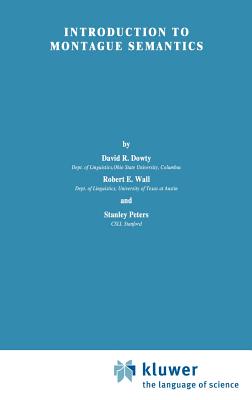
In this book we hope to acquaint the reader with the fundamentals of truth- conditional model-theoretic semantics, and in particular with a version of this developed by Richard Montague in a series of papers published during the 1960's and early 1970's. In many ways the paper 'The Proper Treatment of Quantification in Ordinary English' (commonly abbreviated PTQ) represents the culmination of Montague's efforts to apply the techniques developed within mathematical logic to the semantics of natural languages, and indeed it is the system outlined there that people generally have in mind when they refer to "Montague Grammar". (We prefer the term "Montague Semantics" inasmuch as a grammar, as conceived of in current linguistics, would contain at least a phonological component, a morphological component, and other subsystems which are either lacking entirely or present only in a very rudi- mentary state in the PTQ system. ) Montague's work has attracted increasing attention in recent years among linguists and philosophers since it offers the hope that semantics can be characterized with the same formal rigor and explicitness that transformational approaches have brought to syntax. Whether this hope can be fully realized remains to be seen, but it is clear nonetheless that Montague semantics has already established itself as a productive para- digm, leading to new areas of inquiry and suggesting new ways of conceiving of theories of natural language. Unfortunately, Montague's papers are tersely written and very difficult to follow unless one has a considerable background in logical semantics.
Log in to write a review for this book.
No reviews yet. Be the first to share your opinion.
Biography not available.
Biography not available.
Biography not available.