Buchler, J. Robert Editor
Biography not available.

Browse all FOLKLORE books
Browse all GARDENS books
Browse all GRAPHIC NOVELS books
Browse all HISTORY - MEDIEVAL books
Browse all HUMOUR books
Browse all Juvenile Fiction : Biographical - Other books
Browse all Juvenile Fiction : Historical - Other books
Browse all Juvenile Fiction : Legends, Myths, & Fables - Other books
Browse all Juvenile Fiction : People & Places - Other books
Browse all Juvenile Fiction : People & Places - United States - Other books
Browse all Juvenile Fiction : Religious - Other books
Browse all Juvenile Nonfiction : History - Other books
Browse all Juvenile Nonfiction : Mathematics - Advanced books
Browse all Juvenile Nonfiction : People & Places - Other books
Browse all Juvenile Nonfiction : People & Places - United States - Othe books
Browse all LITERARY STUDIES books
Browse all LONDON books
Browse all Medical : Nursing - Mental Health books
Browse all MIND books
Browse all MUSEOLOGY books
Browse all NON-CLASSIFIABLE books
Browse all NONLINEAR SCIENCE books
Browse all POPULAR SCIENCE books
Browse all RELIGIOUS STUDIES books
Browse all SPIRIT books
Browse all SPORT books
Browse all TRAVEL WRITING books
 Out of Stock
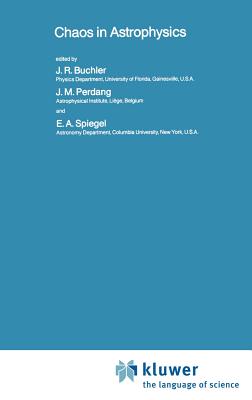
CHAOS IN ASTROPHYSICS 1985/E
Hardback · ISBN 9789027721259
Inclusive of GST and other taxes
Arriving at your doorstep in 10-15 days
Our logisitcs team will make sure everyitem is delivered safely
| ISBN | 9789027721259 |
|---|---|
| Subtitle | CHAOS IN ASTROPHYSICS 1985/E |
| Publisher | Springer |
| Publication date | October 1985 |
| Language | English |
| MRP | £129.99 GBP |
| Page count | 348 |
| Item weight | 147 g |
The per iod of an oscillator tells us much about its structure. J. J. Thomson's deduction that a particle with the e/rn of an electron was in the atom is perhaps the most stunning instance. For us, the deduction of the mean density of a star from its oscillation period is another important example. What then can we deduce about an oscillator that is not periodic? If there are several frequencies or if the behavior is chaotic, may we not hope to learn even more delicate vital statistics about its workings? The recent progress in the theory of dynamical systems, particularly in the elucidat ion of the nature of chaos, makes it seem reasonable to ask this now. This is an account of some of the happenings of a workshop at which this question was raised and discussed. iTe were inc0rested in seeing ways in which the present understanding of chaos might guide astrophysical modelling and the interpretation of observations. But we did not try to conceal that we were also interested in chaos itself, and that made for a pleasant rapport between the chaoticists and astrophysicists at the meeting. We have several introductory papers on chaos in these proceedings, particularly on the analysis of data from systems that may be suspected of chaotic behavior. The papers of Geisel, Grassberger and Guckenheimer introduce the ways of characterizing chaos and Perdang illustrates how some of these ideas may be put into practice in explicit cases.
Log in to write a review for this book.
No reviews yet. Be the first to share your opinion.
Biography not available.
Biography not available.
Biography not available.