Saint-Dizier, P. Editor
Biography not available.

Browse all FOLKLORE books
Browse all GARDENS books
Browse all GRAPHIC NOVELS books
Browse all HISTORY - MEDIEVAL books
Browse all HUMOUR books
Browse all Juvenile Fiction : Biographical - Other books
Browse all Juvenile Fiction : Historical - Other books
Browse all Juvenile Fiction : Legends, Myths, & Fables - Other books
Browse all Juvenile Fiction : People & Places - Other books
Browse all Juvenile Fiction : People & Places - United States - Other books
Browse all Juvenile Fiction : Religious - Other books
Browse all Juvenile Nonfiction : History - Other books
Browse all Juvenile Nonfiction : Mathematics - Advanced books
Browse all Juvenile Nonfiction : People & Places - Other books
Browse all Juvenile Nonfiction : People & Places - United States - Othe books
Browse all LITERARY STUDIES books
Browse all LONDON books
Browse all Medical : Nursing - Mental Health books
Browse all MIND books
Browse all MUSEOLOGY books
Browse all NON-CLASSIFIABLE books
Browse all NONLINEAR SCIENCE books
Browse all POPULAR SCIENCE books
Browse all RELIGIOUS STUDIES books
Browse all SPIRIT books
Browse all SPORT books
Browse all TRAVEL WRITING books
 Out of Stock
PREDICATIVE FORMS IN NATURAL L
Paperback · ISBN 9789048151462
Inclusive of GST and other taxes
Arriving at your doorstep in 10-15 days
Our logisitcs team will make sure everyitem is delivered safely
| ISBN | 9789048151462 |
|---|---|
| Subtitle | PREDICATIVE FORMS IN NATURAL L |
| Publisher | Springer |
| Publication date | December 2010 |
| Language | English |
| MRP | £129.99 GBP |
| Page count | 388 |
| Item weight | 120 g |
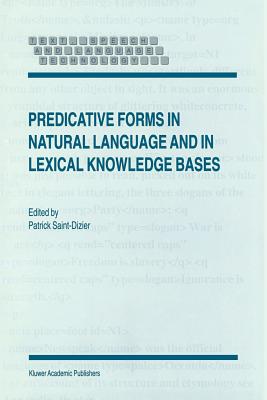
This volume is a selection of papers presented at a workshop entitled Predicative Forms in Natural Language and in Lexical Knowledge Bases organized in Toulouse in August 1996. A predicate is a named relation that exists among one or more arguments. In natural language, predicates are realized as verbs, prepositions, nouns and adjectives, to cite the most frequent ones. Research on the identification, organization, and semantic representa- tion of predicates in artificial intelligence and in language processing is a very active research field. The emergence of new paradigms in theoretical language processing, the definition of new problems and the important evol- ution of applications have, in fact, stimulated much interest and debate on the role and nature of predicates in naturallangage. From a broad theoret- ical perspective, the notion of predicate is central to research on the syntax- semantics interface, the generative lexicon, the definition of ontology-based semantic representations, and the formation of verb semantic classes. From a computational perspective, the notion of predicate plays a cent- ral role in a number of applications including the design of lexical knowledge bases, the development of automatic indexing systems for the extraction of structured semantic representations, and the creation of interlingual forms in machine translation.
Log in to write a review for this book.
No reviews yet. Be the first to share your opinion.
Biography not available.