D'Agostino, M. Editor
Biography not available.

Browse all FOLKLORE books
Browse all GARDENS books
Browse all GRAPHIC NOVELS books
Browse all HISTORY - MEDIEVAL books
Browse all HUMOUR books
Browse all Juvenile Fiction : Biographical - Other books
Browse all Juvenile Fiction : Historical - Other books
Browse all Juvenile Fiction : Legends, Myths, & Fables - Other books
Browse all Juvenile Fiction : People & Places - Other books
Browse all Juvenile Fiction : People & Places - United States - Other books
Browse all Juvenile Fiction : Religious - Other books
Browse all Juvenile Nonfiction : History - Other books
Browse all Juvenile Nonfiction : Mathematics - Advanced books
Browse all Juvenile Nonfiction : People & Places - Other books
Browse all Juvenile Nonfiction : People & Places - United States - Othe books
Browse all LITERARY STUDIES books
Browse all LONDON books
Browse all Medical : Nursing - Mental Health books
Browse all MIND books
Browse all MUSEOLOGY books
Browse all NON-CLASSIFIABLE books
Browse all NONLINEAR SCIENCE books
Browse all POPULAR SCIENCE books
Browse all RELIGIOUS STUDIES books
Browse all SPIRIT books
Browse all SPORT books
Browse all TRAVEL WRITING books
 Out of Stock
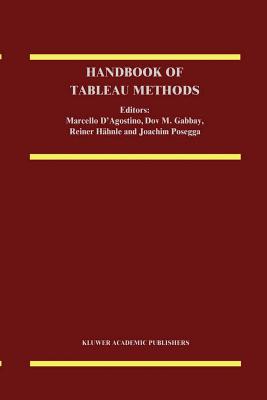
HANDBK OF TABLEAU METHODS
Paperback · ISBN 9789048151844
Inclusive of GST and other taxes
Arriving at your doorstep in 10-15 days
Our logisitcs team will make sure everyitem is delivered safely
| ISBN | 9789048151844 |
|---|---|
| Subtitle | HANDBK OF TABLEAU METHODS |
| Publisher | Springer |
| Publication date | December 2010 |
| Language | English |
| MRP | £179.99 GBP |
| Page count | 680 |
| Item weight | 207 g |
Recent years have been blessed with an abundance of logical systems, arising from a multitude of applications. A logic can be characterised in many different ways. Traditionally, a logic is presented via the following three components: 1. an intuitive non-formal motivation, perhaps tie it in to some application area 2. a semantical interpretation 3. a proof theoretical formulation. There are several types of proof theoretical methodologies, Hilbert style, Gentzen style, goal directed style, labelled deductive system style, and so on. The tableau methodology, invented in the 1950s by Beth and Hintikka and later per- fected by Smullyan and Fitting, is today one of the most popular, since it appears to bring together the proof-theoretical and the semantical approaches to the pre- of a logical system and is also very intuitive. In many universities it is sentation the style first taught to students. Recently interest in tableaux has become more widespread and a community crystallised around the subject. An annual tableaux conference is being held and proceedings are published. The present volume is a Handbook a/Tableaux pre- senting to the community a wide coverage of tableaux systems for a variety of logics. It is written by active members of the community and brings the reader up to frontline research. It will be of interest to any formal logician from any area.
Log in to write a review for this book.
No reviews yet. Be the first to share your opinion.
Biography not available.
Biography not available.
Biography not available.