Pisarenko, V. Author
Biography not available.

Browse all FOLKLORE books
Browse all GARDENS books
Browse all GRAPHIC NOVELS books
Browse all HISTORY - MEDIEVAL books
Browse all HUMOUR books
Browse all Juvenile Fiction : Biographical - Other books
Browse all Juvenile Fiction : Historical - Other books
Browse all Juvenile Fiction : Legends, Myths, & Fables - Other books
Browse all Juvenile Fiction : People & Places - Other books
Browse all Juvenile Fiction : People & Places - United States - Other books
Browse all Juvenile Fiction : Religious - Other books
Browse all Juvenile Nonfiction : History - Other books
Browse all Juvenile Nonfiction : Mathematics - Advanced books
Browse all Juvenile Nonfiction : People & Places - Other books
Browse all Juvenile Nonfiction : People & Places - United States - Othe books
Browse all LITERARY STUDIES books
Browse all LONDON books
Browse all Medical : Nursing - Mental Health books
Browse all MIND books
Browse all MUSEOLOGY books
Browse all NON-CLASSIFIABLE books
Browse all NONLINEAR SCIENCE books
Browse all POPULAR SCIENCE books
Browse all RELIGIOUS STUDIES books
Browse all SPIRIT books
Browse all SPORT books
Browse all TRAVEL WRITING books
 Out of Stock
HEAVY TAILED DISTRIBUTIONS IN
Hardback · ISBN 9789048191703
Inclusive of GST and other taxes
Arriving at your doorstep in 10-15 days
Our logisitcs team will make sure everyitem is delivered safely
| ISBN | 9789048191703 |
|---|---|
| Subtitle | HEAVY TAILED DISTRIBUTIONS IN |
| Publisher | Springer |
| Publication date | August 2010 |
| Language | English |
| MRP | £89.99 GBP |
| Page count | 206 |
| Item weight | 103 g |
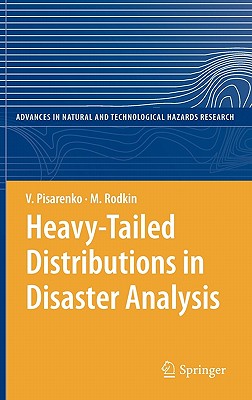
Mathematically, natural disasters of all types are characterized by heavy tailed distributions. The analysis of such distributions with common methods, such as averages and dispersions, can therefore lead to erroneous conclusions. The statistical methods described in this book avoid such pitfalls. Seismic disasters are studied, primarily thanks to the availability of an ample statistical database. New approaches are presented to seismic risk estimation and forecasting the damage caused by earthquakes, ranging from typical, moderate events to very rare, extreme disasters. Analysis of these latter events is based on the limit theorems of probability and the duality of the generalized Pareto distribution and generalized extreme value distribution. It is shown that the parameter most widely used to estimate seismic risk - Mmax, the maximum possible earthquake value - is potentially non-robust. Robust analogues of this parameter are suggested and calculated for some seismic catalogues. Trends in the costs inferred by damage from natural disasters as related to changing social and economic situations are examined for different regions.
The results obtained argue for sustainable development, whereas entirely different, incorrect conclusions can be drawn if the specific properties of the heavy-tailed distribution and change in completeness of data on natural hazards are neglected.
This pioneering work is directed at risk assessment specialists in general, seismologists, administrators and all those interested in natural disasters and their impact on society.
Log in to write a review for this book.
No reviews yet. Be the first to share your opinion.
Biography not available.
Biography not available.