Kihlman, Erika Editor
Biography not available.

Browse all FOLKLORE books
Browse all GARDENS books
Browse all GRAPHIC NOVELS books
Browse all HISTORY - MEDIEVAL books
Browse all HUMOUR books
Browse all Juvenile Fiction : Biographical - Other books
Browse all Juvenile Fiction : Historical - Other books
Browse all Juvenile Fiction : Legends, Myths, & Fables - Other books
Browse all Juvenile Fiction : People & Places - Other books
Browse all Juvenile Fiction : People & Places - United States - Other books
Browse all Juvenile Fiction : Religious - Other books
Browse all Juvenile Nonfiction : History - Other books
Browse all Juvenile Nonfiction : Mathematics - Advanced books
Browse all Juvenile Nonfiction : People & Places - Other books
Browse all Juvenile Nonfiction : People & Places - United States - Othe books
Browse all LITERARY STUDIES books
Browse all LONDON books
Browse all Medical : Nursing - Mental Health books
Browse all MIND books
Browse all MUSEOLOGY books
Browse all NON-CLASSIFIABLE books
Browse all NONLINEAR SCIENCE books
Browse all POPULAR SCIENCE books
Browse all RELIGIOUS STUDIES books
Browse all SPIRIT books
Browse all SPORT books
Browse all TRAVEL WRITING books
 Out of Stock
Paperback · ISBN 9789176351192
Inclusive of GST and other taxes
Arriving at your doorstep in 10-15 days
Our logisitcs team will make sure everyitem is delivered safely
| ISBN | 9789176351192 |
|---|---|
| Publisher | Stockholm University Press |
| Publication date | September 2020 |
| Language | English |
| MRP | £11.00 GBP |
| Page count | 148 |
| Item weight | 48 g |
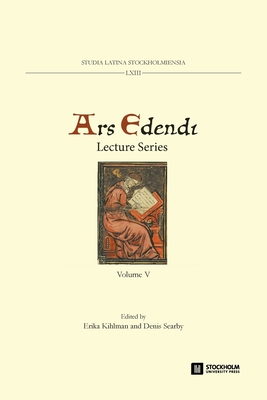
This is the fifth and final volume of lectures on textual criticism and classical philology - broadly understood - given within the framework of the Ars edendi research programme (2008-2015).
Two of the six papers in this volume stem from a 2015 workshop on editorial theory and method, the theme of which dealt with fragments and the writing of commentaries. As regards the former, S. Douglas Olson problematizes the creation and continuation of scholarly knowledge concerning texts that have only come down to us in a fragmentary state, emphazising the challenges and pitfalls that lay in wait for the editor. Benjamin Millis offers a nuanced homage and apology for the traditional text edition with a scholarly commentary, especially underscoring its importance as a connective pathway between text and reader as well as the impetus it can give to scholarly research.
The other four lectures were given at the concluding conference of the Ars edendi programme, held in August 2016. In a case study Cynthia Damon shares her reflections on how to digitally edit Pliny's Natural History in a form that will provide this work's rich reception history and at the same time its extensive use of sources, many of which are now lost. The digital component is also prominent in Odd Einar Haugen's contribution in which he shows that digital mark-up is also an editorial enterprise and how it can be useful for the textual scholar. Dorothea Weber gives an insider's view of the Corpus Scriptorum Ecclesiasticorum Latinorum, an editorial project on-going since 1864, and especially how improved cataloguing has led to numerous discoveries of texts by St. Augustine. As a conclusion to the volume, David Greetham, one of the founders of the Society for Textual Scholarship, reflects on three different methods for editing texts that have undergone various degrees of rescription, namely the oeuvres of Eriugena, Coleridge, and Eliot.
Log in to write a review for this book.
No reviews yet. Be the first to share your opinion.
Biography not available.
Biography not available.