Gómez M., Guillermo L. Author
Biography not available.

Browse all FOLKLORE books
Browse all GARDENS books
Browse all GRAPHIC NOVELS books
Browse all HISTORY - MEDIEVAL books
Browse all HUMOUR books
Browse all Juvenile Fiction : Biographical - Other books
Browse all Juvenile Fiction : Historical - Other books
Browse all Juvenile Fiction : Legends, Myths, & Fables - Other books
Browse all Juvenile Fiction : People & Places - Other books
Browse all Juvenile Fiction : People & Places - United States - Other books
Browse all Juvenile Fiction : Religious - Other books
Browse all Juvenile Nonfiction : History - Other books
Browse all Juvenile Nonfiction : Mathematics - Advanced books
Browse all Juvenile Nonfiction : People & Places - Other books
Browse all Juvenile Nonfiction : People & Places - United States - Othe books
Browse all LITERARY STUDIES books
Browse all LONDON books
Browse all Medical : Nursing - Mental Health books
Browse all MIND books
Browse all MUSEOLOGY books
Browse all NON-CLASSIFIABLE books
Browse all NONLINEAR SCIENCE books
Browse all POPULAR SCIENCE books
Browse all RELIGIOUS STUDIES books
Browse all SPIRIT books
Browse all SPORT books
Browse all TRAVEL WRITING books
 Out of Stock
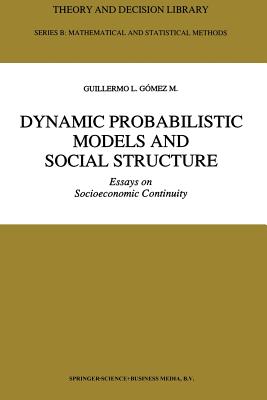
DYNAMIC PROBABILISTIC MODELS &
Paperback · ISBN 9789401051149
Inclusive of GST and other taxes
Arriving at your doorstep in 10-15 days
Our logisitcs team will make sure everyitem is delivered safely
| ISBN | 9789401051149 |
|---|---|
| Subtitle | DYNAMIC PROBABILISTIC MODELS & |
| Publisher | Springer |
| Publication date | November 2012 |
| Language | English |
| MRP | £44.99 GBP |
| Page count | 468 |
| Item weight | 144 g |
Mathematical models have been very successful in the study of the physical world. Galilei and Newton introduced point particles moving without friction under the action of simple forces as the basis for the description of concrete motions like the ones of the planets. This approach was sustained by appro- priate mathematical methods, namely infinitesimal calculus, which was being developed at that time. In this way classical analytical mechanics was able to establish some general results, gaining insight through explicit solution of some simple cases and developing various methods of approximation for handling more complicated ones. Special relativity theory can be seen as an extension of this kind of modelling. In the study of electromagnetic phenomena and in general relativity another mathematical model is used, in which the concept of classical field plays the fundamental role. The equations of motion here are partial differential equations, and the methods of study used involve further developments of classical analysis. These models are deterministic in nature. However it was realized already in the second half of last century, through the work of Maxwell, Boltzmann, Gibbs and others, that in the discussion of systems involving a great number of particles, the deterministic description is not by itself of great help, in particu- lar a suitable "weighting" of all possible initial conditions should be considered.
Log in to write a review for this book.
No reviews yet. Be the first to share your opinion.
Biography not available.