Holler, M.J. Editor
Biography not available.

Browse all FOLKLORE books
Browse all GARDENS books
Browse all GRAPHIC NOVELS books
Browse all HISTORY - MEDIEVAL books
Browse all HUMOUR books
Browse all Juvenile Fiction : Biographical - Other books
Browse all Juvenile Fiction : Historical - Other books
Browse all Juvenile Fiction : Legends, Myths, & Fables - Other books
Browse all Juvenile Fiction : People & Places - Other books
Browse all Juvenile Fiction : People & Places - United States - Other books
Browse all Juvenile Fiction : Religious - Other books
Browse all Juvenile Nonfiction : History - Other books
Browse all Juvenile Nonfiction : Mathematics - Advanced books
Browse all Juvenile Nonfiction : People & Places - Other books
Browse all Juvenile Nonfiction : People & Places - United States - Othe books
Browse all LITERARY STUDIES books
Browse all LONDON books
Browse all Medical : Nursing - Mental Health books
Browse all MIND books
Browse all MUSEOLOGY books
Browse all NON-CLASSIFIABLE books
Browse all NONLINEAR SCIENCE books
Browse all POPULAR SCIENCE books
Browse all RELIGIOUS STUDIES books
Browse all SPIRIT books
Browse all SPORT books
Browse all TRAVEL WRITING books
 Out of Stock
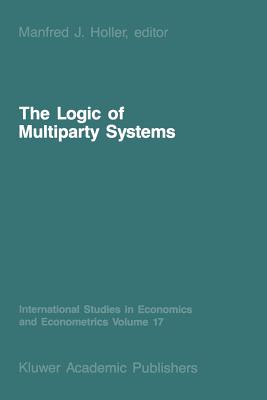
LOGIC OF MULTIPARTY SYSTEMS SO
Paperback · ISBN 9789401081146
Inclusive of GST and other taxes
Arriving at your doorstep in 10-15 days
Our logisitcs team will make sure everyitem is delivered safely
| ISBN | 9789401081146 |
|---|---|
| Subtitle | LOGIC OF MULTIPARTY SYSTEMS SO |
| Publisher | Springer |
| Publication date | September 2011 |
| Language | English |
| MRP | £44.99 GBP |
| Page count | 452 |
| Item weight | 139 g |
What determines the number of political parties in a democracy? Electoral rules certainly influence the incentives to create and maintain parties. However, a society's political culture can maintain parties despite electoral rules that give them poor prospects of success. Thus, comparing the number of parties and differences in electoral rules across countries cannot clearly test the effect of the electoral rules. A better test would examine a society with a fairly continuous political culture, but a change in electoral rules. Postwar France is such a society. While the basic social order has not changed, there was a drastic change in the electoral system in 1958, which theory implies would reduce the number of parties. Thus we can test the hypothesis that the number of parties fell with the change in electoral system. We can also calculate an " equivalent number of parties- to see how closely France approached a two - party system under the new regime. The first section describes the electoral rules under the Fourth and Fifth Republics. The second section develops a model that indicates how the change in electoral rules should have affected the incentives for multiple parties. The third section tests the hypothesis that the number of parties fell from the Fourth to the Fifth Republic. 1. Electoral Rules In the French Fourth Republic (1945 - 1958) political parties existed largely to serve the direct interests of their members.
Log in to write a review for this book.
No reviews yet. Be the first to share your opinion.
Biography not available.