Geshi, Masaaki Editor
Biography not available.

Browse all FOLKLORE books
Browse all GARDENS books
Browse all GRAPHIC NOVELS books
Browse all HISTORY - MEDIEVAL books
Browse all HUMOUR books
Browse all Juvenile Fiction : Biographical - Other books
Browse all Juvenile Fiction : Historical - Other books
Browse all Juvenile Fiction : Legends, Myths, & Fables - Other books
Browse all Juvenile Fiction : People & Places - Other books
Browse all Juvenile Fiction : People & Places - United States - Other books
Browse all Juvenile Fiction : Religious - Other books
Browse all Juvenile Nonfiction : History - Other books
Browse all Juvenile Nonfiction : Mathematics - Advanced books
Browse all Juvenile Nonfiction : People & Places - Other books
Browse all Juvenile Nonfiction : People & Places - United States - Othe books
Browse all LITERARY STUDIES books
Browse all LONDON books
Browse all Medical : Nursing - Mental Health books
Browse all MIND books
Browse all MUSEOLOGY books
Browse all NON-CLASSIFIABLE books
Browse all NONLINEAR SCIENCE books
Browse all POPULAR SCIENCE books
Browse all RELIGIOUS STUDIES books
Browse all SPIRIT books
Browse all SPORT books
Browse all TRAVEL WRITING books
 Out of Stock
Paperback · ISBN 9789811361968
Inclusive of GST and other taxes
Arriving at your doorstep in 10-15 days
Our logisitcs team will make sure everyitem is delivered safely
| ISBN | 9789811361968 |
|---|---|
| Publisher | Springer |
| Publication date | August 2020 |
| Language | English |
| MRP | £109.99 GBP |
| Page count | 232 |
| Item weight | 73 g |
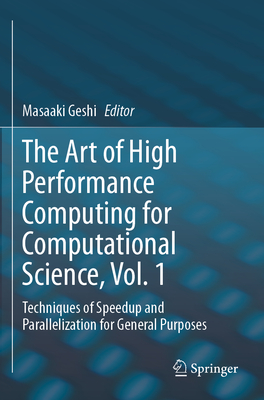
Starting with an introduction to the recent trends in computer architecture and parallel processing, Chapter 1 explains the basic knowledge of speedup programs with simple examples of numerical computing. Chapters 2 - 4 detail the basics of parallel programming, the message passing interface (MPI), and OpenMP and discuss hybrid parallelization techniques. Showing an actual example of adaptation, Chapter 5 gives an overview of performance tuning and communication optimizations. To deal with dense matrix calculations, Chapter 6 details the basics and practice of linear algebra calculation libraries BLAS and LAPACK, including some examples that can be easily reproduced by readers using free software. Focusing on sparse matrix calculations, Chapter 7 explains high performance algorithms for numerical linear algebra. Chapter 8 introduces the fast Fourier transform in large-scale systems from the basics. Chapter 9 explains optimization and related topics such as debug methods and version control systems. Chapter 10 discusses techniques for increasing computation accuracy as an essential topic in numerical calculation.
This is the first of the two volumes that grew out of a series of lectures in the K computer project in Japan. The second volume will focus on advanced techniques and examples of applications in materials science.
Log in to write a review for this book.
No reviews yet. Be the first to share your opinion.
Biography not available.