Marwala, Tshilidzi Author
Biography not available.

Browse all FOLKLORE books
Browse all GARDENS books
Browse all GRAPHIC NOVELS books
Browse all HISTORY - MEDIEVAL books
Browse all HUMOUR books
Browse all Juvenile Fiction : Biographical - Other books
Browse all Juvenile Fiction : Historical - Other books
Browse all Juvenile Fiction : Legends, Myths, & Fables - Other books
Browse all Juvenile Fiction : People & Places - Other books
Browse all Juvenile Fiction : People & Places - United States - Other books
Browse all Juvenile Fiction : Religious - Other books
Browse all Juvenile Nonfiction : History - Other books
Browse all Juvenile Nonfiction : Mathematics - Advanced books
Browse all Juvenile Nonfiction : People & Places - Other books
Browse all Juvenile Nonfiction : People & Places - United States - Othe books
Browse all LITERARY STUDIES books
Browse all LONDON books
Browse all Medical : Nursing - Mental Health books
Browse all MIND books
Browse all MUSEOLOGY books
Browse all NON-CLASSIFIABLE books
Browse all NONLINEAR SCIENCE books
Browse all POPULAR SCIENCE books
Browse all RELIGIOUS STUDIES books
Browse all SPIRIT books
Browse all SPORT books
Browse all TRAVEL WRITING books
 Out of Stock
Hardback · ISBN 9789814630863
Inclusive of GST and other taxes
Arriving at your doorstep in 10-15 days
Our logisitcs team will make sure everyitem is delivered safely
| ISBN | 9789814630863 |
|---|---|
| Publisher | World Scientific |
| Publication date | January 2015 |
| Language | English |
| MRP | £88.00 GBP |
| Page count | 208 |
| Item weight | 118 g |
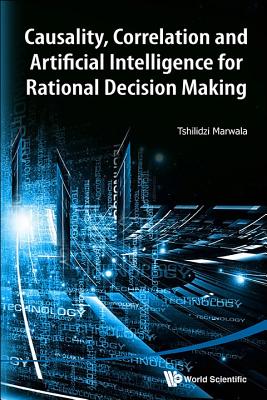
Causality has been a subject of study for a long time. Often causality is confused with correlation. Human intuition has evolved such that it has learned to identify causality through correlation. In this book, four main themes are considered and these are causality, correlation, artificial intelligence and decision making. A correlation machine is defined and built using multi-layer perceptron network, principal component analysis, Gaussian Mixture models, genetic algorithms, expectation maximization technique, simulated annealing and particle swarm optimization. Furthermore, a causal machine is defined and built using multi-layer perceptron, radial basis function, Bayesian statistics and Hybrid Monte Carlo methods. Both these machines are used to build a Granger non-linear causality model. In addition, the Neyman-Rubin, Pearl and Granger causal models are studied and are unified. The automatic relevance determination is also applied to extend Granger causality framework to the non-linear domain. The concept of rational decision making is studied, and the theory of flexibly-bounded rationality is used to extend the theory of bounded rationality within the principle of the indivisibility of rationality. The theory of the marginalization of irrationality for decision making is also introduced to deal with satisficing within irrational conditions. The methods proposed are applied in biomedical engineering, condition monitoring and for modelling interstate conflict.
Log in to write a review for this book.
No reviews yet. Be the first to share your opinion.
Biography not available.