Mathur, Garima Author
Biography not available.

Browse all FOLKLORE books
Browse all GARDENS books
Browse all GRAPHIC NOVELS books
Browse all HISTORY - MEDIEVAL books
Browse all HUMOUR books
Browse all Juvenile Fiction : Biographical - Other books
Browse all Juvenile Fiction : Historical - Other books
Browse all Juvenile Fiction : Legends, Myths, & Fables - Other books
Browse all Juvenile Fiction : People & Places - Other books
Browse all Juvenile Fiction : People & Places - United States - Other books
Browse all Juvenile Fiction : Religious - Other books
Browse all Juvenile Nonfiction : History - Other books
Browse all Juvenile Nonfiction : Mathematics - Advanced books
Browse all Juvenile Nonfiction : People & Places - Other books
Browse all Juvenile Nonfiction : People & Places - United States - Othe books
Browse all LITERARY STUDIES books
Browse all LONDON books
Browse all Medical : Nursing - Mental Health books
Browse all MIND books
Browse all MUSEOLOGY books
Browse all NON-CLASSIFIABLE books
Browse all NONLINEAR SCIENCE books
Browse all POPULAR SCIENCE books
Browse all RELIGIOUS STUDIES books
Browse all SPIRIT books
Browse all SPORT books
Browse all TRAVEL WRITING books
 Out of Stock
Paperback · ISBN 9789999347648
Inclusive of GST and other taxes
Arriving at your doorstep in 10-15 days
Our logisitcs team will make sure everyitem is delivered safely
| ISBN | 9789999347648 |
|---|---|
| Publisher | Eliva Press |
| Publication date | September 2026 |
| Language | English |
| MRP | £49.50 GBP |
| Page count | 66 |
| Item weight | 23 g |
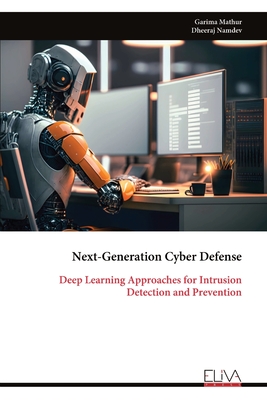
Cybersecurity has become one of the most critical challenges of the digital era, with the rapid growth of cloud computing, the Internet of Things (IoT), Industrial IoT (IIoT), and interconnected smart systems. Traditional intrusion detection methods struggle to identify sophisticated and previously unseen cyberattacks, creating a pressing need for intelligent, adaptive, and real-time security solutions. Next-Generation Cyber Defense: Deep Learning Approaches for Intrusion Detection and Prevention presents advanced artificial intelligence techniques for designing highly effective Intrusion Detection and Prevention Systems (IDPS). The book introduces two novel frameworks: the DCNN-BiGRU hybrid deep learning model, which combines Deep Convolutional Neural Networks with Bidirectional Gated Recurrent Units for accurate multiclass attack detection, and the Leading Ensemble Decision Classifier Module (LEDCM), an innovative online ensemble framework that enhances prediction accuracy through dynamic class-wise leader selection. These models achieve outstanding performance on benchmark cybersecurity datasets, demonstrating their effectiveness in detecting both known and emerging cyber threats. The book provides a comprehensive overview of intrusion detection systems, machine learning and deep learning techniques, ensemble learning, feature engineering, data preprocessing, performance evaluation, and real-world implementation using benchmark datasets. It bridges theoretical concepts with practical methodologies, enabling readers to understand, design, and deploy intelligent cyber defense systems for modern network environments. In addition, it explores emerging research directions such as explainable AI, federated learning, adversarial robustness, and edge-based intrusion detection, offering valuable insights into the future of cybersecurity. Designed for researchers, postgraduate students, cybersecurity professionals, and AI practitioners, this book serves as both an academic reference and a practical guide. By integrating cutting-edge deep learning architectures with robust ensemble techniques, it provides scalable and reliable solutions for protecting next-generation.
Log in to write a review for this book.
No reviews yet. Be the first to share your opinion.
Biography not available.
Biography not available.