Xu, Cheng Author
Biography not available.

Browse all FOLKLORE books
Browse all GARDENS books
Browse all GRAPHIC NOVELS books
Browse all HISTORY - MEDIEVAL books
Browse all HUMOUR books
Browse all Juvenile Fiction : Biographical - Other books
Browse all Juvenile Fiction : Historical - Other books
Browse all Juvenile Fiction : Legends, Myths, & Fables - Other books
Browse all Juvenile Fiction : People & Places - Other books
Browse all Juvenile Fiction : People & Places - United States - Other books
Browse all Juvenile Fiction : Religious - Other books
Browse all Juvenile Nonfiction : History - Other books
Browse all Juvenile Nonfiction : Mathematics - Advanced books
Browse all Juvenile Nonfiction : People & Places - Other books
Browse all Juvenile Nonfiction : People & Places - United States - Othe books
Browse all LITERARY STUDIES books
Browse all LONDON books
Browse all Medical : Nursing - Mental Health books
Browse all MIND books
Browse all MUSEOLOGY books
Browse all NON-CLASSIFIABLE books
Browse all NONLINEAR SCIENCE books
Browse all POPULAR SCIENCE books
Browse all RELIGIOUS STUDIES books
Browse all SPIRIT books
Browse all SPORT books
Browse all TRAVEL WRITING books
 Out of Stock
Paperback · ISBN 9789999351287
Inclusive of GST and other taxes
Arriving at your doorstep in 10-15 days
Our logisitcs team will make sure everyitem is delivered safely
| ISBN | 9789999351287 |
|---|---|
| Publisher | Eliva Press |
| Publication date | September 2026 |
| Language | English |
| MRP | £45.50 GBP |
| Page count | 50 |
| Item weight | 18 g |
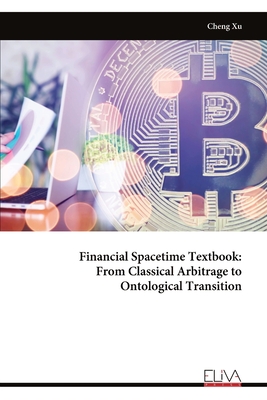
Financial Spacetime Textbook: From Classical Arbitrage to Ontological Transition offers a radical re-founding of how we understand markets, wealth, and risk. Drawing on the successive revolutions of physics-from Newtonian absolute space and time, through Einsteinian curved spacetime, to quantum measurement and many-worlds branching-it equips readers with a powerful new geometric language for finance. The book progresses through three levels of arbitrage. Classical arbitrage is the work of the porter: eliminating price discrepancies inside a fixed, flat geometry. Relativistic arbitrage is the work of the gardener: diagnosing when an entire credit system is curving toward collapse and switching the wealth worldline into a more stable continuum before the event horizon closes. The highest level is spacetime engineering-the architect's art of creating entirely new value continua and the wormholes that connect them. Along the way the text examines liquidity black holes, the information paradox of systemic crises, the observer effect in algorithmic markets, and the ethics of exit when elites can change maps while others remain behind. Anchored in rigorous literature yet written with philosophical clarity, this textbook speaks to serious investors, portfolio managers, policymakers, scholars, and intellectually ambitious readers who sense that conventional finance has reached the limits of its Newtonian paradigm. In an age of monetary experimentation, technological discontinuity, and recurring systemic stress, Financial Spacetime provides both a diagnostic toolkit and a call to higher agency: stop merely repairing the old geometry-learn to read its curvature, migrate when necessary, and, when possible, help build the next one. Where will your worldline lead?
Log in to write a review for this book.
No reviews yet. Be the first to share your opinion.
Biography not available.