Harwell, Marcus D. Author
Biography not available.

Browse all FOLKLORE books
Browse all GARDENS books
Browse all GRAPHIC NOVELS books
Browse all HISTORY - MEDIEVAL books
Browse all HUMOUR books
Browse all Juvenile Fiction : Biographical - Other books
Browse all Juvenile Fiction : Historical - Other books
Browse all Juvenile Fiction : Legends, Myths, & Fables - Other books
Browse all Juvenile Fiction : People & Places - Other books
Browse all Juvenile Fiction : People & Places - United States - Other books
Browse all Juvenile Fiction : Religious - Other books
Browse all Juvenile Nonfiction : History - Other books
Browse all Juvenile Nonfiction : Mathematics - Advanced books
Browse all Juvenile Nonfiction : People & Places - Other books
Browse all Juvenile Nonfiction : People & Places - United States - Othe books
Browse all LITERARY STUDIES books
Browse all LONDON books
Browse all Medical : Nursing - Mental Health books
Browse all MIND books
Browse all MUSEOLOGY books
Browse all NON-CLASSIFIABLE books
Browse all NONLINEAR SCIENCE books
Browse all POPULAR SCIENCE books
Browse all RELIGIOUS STUDIES books
Browse all SPIRIT books
Browse all SPORT books
Browse all TRAVEL WRITING books
 Out of Stock
Paperback · ISBN 9798172141867
Inclusive of GST and other taxes
Arriving at your doorstep in 10-15 days
Our logisitcs team will make sure everyitem is delivered safely
| ISBN | 9798172141867 |
|---|---|
| Publisher | Independently published |
| Publication date | September 2026 |
| Language | English |
| MRP | £62.88 GBP |
| Page count | 554 |
| Item weight | 280 g |
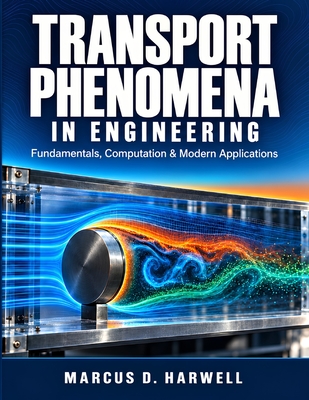
Momentum, heat, and mass transfer are usually taught as three separate subjects, in three separate courses, from three separate books. An engineer finishes that sequence able to compute a friction factor and a heat-transfer coefficient, yet unable to see that the two calculations share a structure. Then a real problem arrives in which a fluid is moving, a wall is hot, and a species is crossing an interface at once, and there is no method available, only three disconnected habits.
The knowledge is not missing. It is fragmented. Correlations get applied outside the range they were fitted in, because nobody explained what the range meant. Dimensionless groups get treated as algebra rather than as statements about which mechanism is winning. A simulation returns a plausible colored picture and no one can say whether it deserves to be believed.
This comprehensive twenty-two-chapter reference treats transport as one discipline with three expressions. One sequence is stated at the outset and never abandoned: write a conservation balance, identify every mechanism crossing the boundary, supply a constitutive law linking flux to gradient, estimate the scales, solve with the simplest adequate method, and verify the result. Read it straight through, or open it at one of its two hundred numbered sections when a specific answer is needed.
Inside this book you willKey topics: conservation balances in integral and differential form; rheology and constitutive-model selection; laminar and turbulent flow; pressure drop and flow networks; conduction; forced and natural convection; radiation in enclosures; multicomponent diffusion; catalyst effectiveness; interphase transfer and separation contacting; coupled transport with phase change; porous, electrochemical, and transient biological systems; computational fluid dynamics; and verification, validation, and uncertainty quantification. batteries, hydrogen, carbon capture, and biomedical transport.
More than sixty figures each carry a specific argument, and the apparatus includes a nomenclature of symbols and dimensionless groups, a glossary, and an index keyed to section numbers rather than pages.
Who it is for: practicing chemical, mechanical, process, energy, and biomedical engineers whose designs depend on getting transport right; simulation engineers who must justify a computed result; and readers taking or teaching a first course who want the three modes as one subject.
Open the book and begin building the one method that turns momentum, heat, and mass transfer from three catalogs of equations into three connected ways of reading how engineering systems move what they carry.
Log in to write a review for this book.
No reviews yet. Be the first to share your opinion.
Biography not available.