Công, Vu Trí|| Author
Biography not available.

Browse all FOLKLORE books
Browse all GARDENS books
Browse all GRAPHIC NOVELS books
Browse all HISTORY - MEDIEVAL books
Browse all HUMOUR books
Browse all Juvenile Fiction : Biographical - Other books
Browse all Juvenile Fiction : Historical - Other books
Browse all Juvenile Fiction : Legends, Myths, & Fables - Other books
Browse all Juvenile Fiction : People & Places - Other books
Browse all Juvenile Fiction : People & Places - United States - Other books
Browse all Juvenile Fiction : Religious - Other books
Browse all Juvenile Nonfiction : History - Other books
Browse all Juvenile Nonfiction : Mathematics - Advanced books
Browse all Juvenile Nonfiction : People & Places - Other books
Browse all Juvenile Nonfiction : People & Places - United States - Othe books
Browse all LITERARY STUDIES books
Browse all LONDON books
Browse all Medical : Nursing - Mental Health books
Browse all MIND books
Browse all MUSEOLOGY books
Browse all NON-CLASSIFIABLE books
Browse all NONLINEAR SCIENCE books
Browse all POPULAR SCIENCE books
Browse all RELIGIOUS STUDIES books
Browse all SPIRIT books
Browse all SPORT books
Browse all TRAVEL WRITING books
 Out of Stock
Paperback · ISBN 9798172728174
Inclusive of GST and other taxes
Arriving at your doorstep in 10-15 days
Our logisitcs team will make sure everyitem is delivered safely
| ISBN | 9798172728174 |
|---|---|
| Publisher | Independently published |
| Publication date | September 2026 |
| Language | English |
| MRP | £9.59 GBP |
| Page count | 228 |
| Item weight | 69 g |
Three Mondays, and none of them is an algorithm problem.
On the first, an executive committee is shown three figures for the same month's revenue - all three computed correctly. On the second, a forecasting model that nobody acted on, because the person it was built for had no way to see it when they ordered and no way to disagree that anyone recorded. On the third, software placing an order using a definition of stock cover that had changed eleven days earlier. The change was announced in a meeting. The software was not at the meeting.
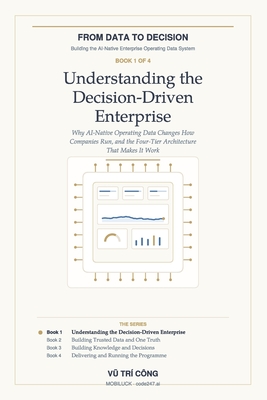
Book 1 of From Data to Decision sets out the argument and the architecture that make all three impossible.
Part I - Know. Why the value of data is realised in decisions; the four tiers a fact crosses on its way to an action; what "AI-native" actually means; eight design principles a board should approve, each with the price of keeping it and the larger price of breaking it; the autonomy ladder from L0 to L4; a self-assessment; and a roadmap whose phases end on numbers rather than on dates.
Part II - Understand. Eleven views of the same system: the principles as enforceable constraints, the five seams where quality is decided, each tier's obligations, the role, technology, data, consumption and integration views, the cross-cutting layers, governance and operations, a sixteen-group capability map, and a worked target architecture.
Every chapter closes with a five-step "Putting it to work" - concrete actions with owners and timeboxes, starting with the week-one exercise that produces the four numbers every later claim is measured against.
An executive can read Part I in an evening. An architect needs both.
Log in to write a review for this book.
No reviews yet. Be the first to share your opinion.
Biography not available.