Nehme, Charles Author
Biography not available.

Browse all FOLKLORE books
Browse all GARDENS books
Browse all GRAPHIC NOVELS books
Browse all HISTORY - MEDIEVAL books
Browse all HUMOUR books
Browse all Juvenile Fiction : Biographical - Other books
Browse all Juvenile Fiction : Historical - Other books
Browse all Juvenile Fiction : Legends, Myths, & Fables - Other books
Browse all Juvenile Fiction : People & Places - Other books
Browse all Juvenile Fiction : People & Places - United States - Other books
Browse all Juvenile Fiction : Religious - Other books
Browse all Juvenile Nonfiction : History - Other books
Browse all Juvenile Nonfiction : Mathematics - Advanced books
Browse all Juvenile Nonfiction : People & Places - Other books
Browse all Juvenile Nonfiction : People & Places - United States - Othe books
Browse all LITERARY STUDIES books
Browse all LONDON books
Browse all Medical : Nursing - Mental Health books
Browse all MIND books
Browse all MUSEOLOGY books
Browse all NON-CLASSIFIABLE books
Browse all NONLINEAR SCIENCE books
Browse all POPULAR SCIENCE books
Browse all RELIGIOUS STUDIES books
Browse all SPIRIT books
Browse all SPORT books
Browse all TRAVEL WRITING books
 Out of Stock
Paperback · ISBN 9798172757358
Inclusive of GST and other taxes
Arriving at your doorstep in 10-15 days
Our logisitcs team will make sure everyitem is delivered safely
| ISBN | 9798172757358 |
|---|---|
| Publisher | Independently published |
| Publication date | September 2026 |
| Language | English |
| MRP | £36.90 GBP |
| Page count | 446 |
| Item weight | 118 g |
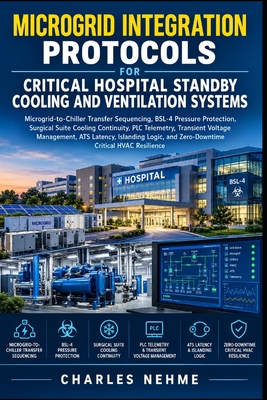
Modern hospitals depend on HVAC systems not simply for comfort, but for patient safety, infection control, environmental stability, equipment protection, and continuity of clinical operations. In critical healthcare environments, the loss of cooling or ventilation for even a short period can create consequences that extend far beyond an uncomfortable building.
Operating rooms require stable environmental conditions. Intensive-care areas depend on reliable ventilation. Isolation environments require controlled airflow relationships. Laboratories may require continuous temperature and pressure control. Highly specialized containment environments, including BSL-4 facilities, demand particularly robust ventilation strategies. At the same time, the electrical infrastructure supporting these systems must remain operational when the normal utility supply is interrupted.
This creates a complex engineering challenge: the electrical transition to standby or islanded power must be coordinated with the mechanical behavior of chillers, pumps, air-handling units, fans, variable-frequency drives, controls, and heat-rejection equipment.
A generator starting successfully does not automatically mean that the hospital's cooling system will continue operating successfully.
The critical question is what happens during the transition.
This book examines that transition from an integrated electrical and HVAC perspective. It focuses on the sequence of events beginning with the loss of the primary utility supply and continuing through detection, transfer, microgrid stabilization, HVAC load prioritization, chiller operation, ventilation preservation, pressure control, and eventual restoration of normal operation.
The objective is not to present a theoretical discussion of microgrids. Instead, the emphasis is on practical engineering protocols that can be incorporated into design reviews, controls development, commissioning programs, facility procedures, and resilience assessments.
Particular attention is given to the interaction between:
The book also addresses the importance of telemetry. A transfer event may occur within seconds, yet understanding exactly what happened requires detailed information from electrical and mechanical systems. Voltage disturbances, frequency deviations, control-system responses, equipment trips, communication delays, and restart behavior can reveal weaknesses that may remain invisible during ordinary operation.
The approach throughout this book is deliberately formula-free. Engineering concepts are explained through descriptive procedures, operational sequences, tables, checklists, failure scenarios, control strategies, and commissioning practices rather than mathematical equations.
The goal is to help engineers and facility teams answer practical questions:
What should happen when the utility fails?
Which HVAC loads should transfer first?
How should the chiller plant respond?
How can ventilation be maintained while electrical power is transitioning?
How can pressure relationships be protected?
What telemetry should be recorded?
Log in to write a review for this book.
No reviews yet. Be the first to share your opinion.
Biography not available.