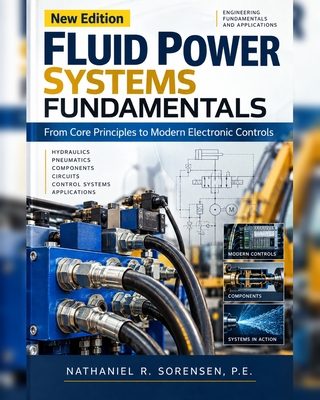
Cover of Fluid Power Systems Fundamentals: From Core Principles to Modern Electronic Controls by Sorensen, Nathaniel R., ISBN 9798172867040
General

Fluid Power Systems Fundamentals: From Core Principles to Modern Electronic Controls

Contributor(s): Author Format: Paperback

Paperback ยท ISBN 9798172867040

โ‚น14,587 2%
โ‚น14,961

Inclusive of GST and other taxes

100% Quality Assurance
No Account Creation Required
Fast Delivery
Secured Transactions

Arriving at your doorstep in 10-15 days

Our logisitcs team will make sure everyitem is delivered safely

Key Specifications

ISBN 9798172867040
Publisher Independently published
Publication date September 2026
Language English
MRP ยฃ115.98 GBP
Page count 278
Item weight 123 g
Fluid power runs quietly beneath nearly every industry that lifts, presses, moves, or holds a load under force, yet most technicians learn its components one at a time, in isolation, with troubleshooting saved for a single chapter near the end of the course. That approach leaves a gap: a technician who can name a valve's parts but struggles to reason through why a machine is behaving strangely on the shop floor today.
This book closes that gap by applying one consistent analytical framework to every hydraulic, pneumatic, and electrical control topic it covers, so that diagnostic thinking develops alongside component knowledge from the very first chapter rather than being treated as a separate skill learned later. Every chapter walks through the same four questions: what a component is for, how it is arranged in a circuit, how it behaves during normal operation, and what observable signs indicate it is beginning to fail.
Across eighteen chapters, readers move from foundational pressure-and-flow principles and hydraulic system fundamentals through fluid conductors, pumps, directional and flow control valves, actuators, and pressure control valves, then into hydraulic fluid properties and contamination control, and a full chapter dedicated to systematic hydraulic troubleshooting built on first-principles reasoning. Pneumatic system fundamentals, compression and control, and conditioning follow, before the book turns to the control layer increasingly wrapped around fluid power today: classical relay logic and ladder diagrams, modern electronic and proportional valve control, and programmable logic controller integration, closing with integrated circuit design and a chapter on safety, standards, and career pathways.
Working through this book, readers will be able to:
  • Reason through an unfamiliar hydraulic or pneumatic fault using first principles rather than guesswork
  • Read and interpret standard fluid power schematic symbols with confidence
  • Select, size, and evaluate pumps, valves, actuators, hoses, and fittings for a given application
  • Recognize contamination, wear, and fluid-condition warning signs before they become failures
  • Practice this reasoning through applied scenarios spanning mobile equipment, industrial presses, marine systems, and precision agriculture
  • Bridge classical relay-based control into modern proportional and PLC-integrated systems
  • Apply core fluid power safety, lockout/tagout, and stored-energy practices with confidence
This book is written for maintenance and field service technicians, apprentices and technician-track students in formal fluid power or industrial maintenance programs, and working mechanical and controls personnel who need one sequential reference connecting classical fluid power fundamentals to the electronic controls now built into most modern machinery.
Start building diagnostic fluency in fluid power from first principles, one component and one circuit at a time, with a guide structured specifically around the reasoning technicians actually need on the job.