Kallund, Zakif Author
Biography not available.

Browse all FOLKLORE books
Browse all GARDENS books
Browse all GRAPHIC NOVELS books
Browse all HISTORY - MEDIEVAL books
Browse all HUMOUR books
Browse all Juvenile Fiction : Biographical - Other books
Browse all Juvenile Fiction : Historical - Other books
Browse all Juvenile Fiction : Legends, Myths, & Fables - Other books
Browse all Juvenile Fiction : People & Places - Other books
Browse all Juvenile Fiction : People & Places - United States - Other books
Browse all Juvenile Fiction : Religious - Other books
Browse all Juvenile Nonfiction : History - Other books
Browse all Juvenile Nonfiction : Mathematics - Advanced books
Browse all Juvenile Nonfiction : People & Places - Other books
Browse all Juvenile Nonfiction : People & Places - United States - Othe books
Browse all KINDRED books
Browse all LITERARY STUDIES books
Browse all LONDON books
Browse all Medical : Nursing - Mental Health books
Browse all MIND books
Browse all MUSEOLOGY books
Browse all NON-CLASSIFIABLE books
Browse all NONLINEAR SCIENCE books
Browse all Ormonde books
Browse all POPULAR SCIENCE books
Browse all RELIGIOUS STUDIES books
Browse all SPIRIT books
Browse all SPORT books
Browse all TRAVEL WRITING books
 Out of Stock
Paperback · ISBN 9798173008084
Inclusive of GST and other taxes
Arriving at your doorstep in 10-15 days
Our logisitcs team will make sure everyitem is delivered safely
| ISBN | 9798173008084 |
|---|---|
| Publisher | Independently published |
| Publication date | September 2026 |
| Language | English |
| MRP | £20.67 GBP |
| Page count | 162 |
| Item weight | 87 g |
That belief is what leaves scrap bins untouched for years, waiting on fabric that never quite arrives. A finished block reads as a clear pattern or dissolves into visual mush for one reason: value, how light or dark a fabric reads once color is stripped away, not whether two prints match. A cranberry print and a forest green print with the same medium-dark value sit together in a block just fine, even though they clash on a paint chip, and a bin sorted this way reads as an organized materials list, not a pile.
What Sorting Actually Fixes
Eight technique chapters build every skill a pattern will call on before it calls on it, so nothing in a project is ever left to a guess partway through construction.
Cutting Charts Built to Match the Photo
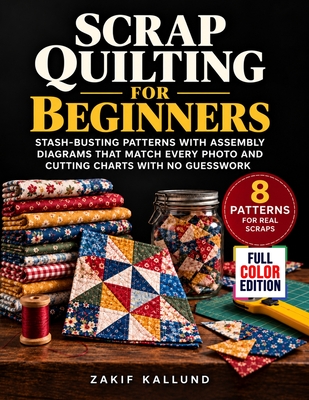
Every one of the eight patterns states an exact cutting count and size for every piece it calls for, and every assembly diagram is numbered and labeled to match the finished photograph piece for piece, at any stage a reader stops to check it against the pattern.
Pick a light, a medium, and a dark scrap out of the bin this weekend, and start with the table runner in the first pattern chapter.
Log in to write a review for this book.
No reviews yet. Be the first to share your opinion.
Biography not available.