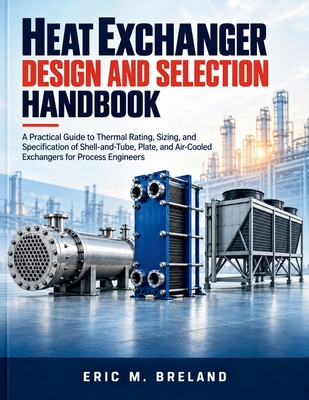
Cover of Heat Exchanger Design and Selection Handbook: A Practical Guide to Thermal Rating, Sizing, and Specification of Shell-and-Tube, Plate, and Air-Cooled by M. Breland, Eric, ISBN 9798174408043
Mechanics

Heat Exchanger Design and Selection Handbook: A Practical Guide to Thermal Rating, Sizing, and Specification of Shell-and-Tube, Plate, and Air-Cooled

Contributor(s): Author Format: Paperback

Paperback ยท ISBN 9798174408043

โ‚น8,188 3%
โ‚น8,398

Inclusive of GST and other taxes

100% Quality Assurance
No Account Creation Required
Fast Delivery
Secured Transactions

Arriving at your doorstep in 10-15 days

Our logisitcs team will make sure everyitem is delivered safely

Key Specifications

ISBN 9798174408043
Publisher Independently published
Publication date September 2026
Language English
MRP ยฃ65.10 GBP
Page count 502
Item weight 254 g
Two questions open every heat transfer equipment project: which exchanger the service calls for, and how large it must be. They are asked in that order, answered by different people, and treated as separate problems - and that separation is where the most expensive decisions on a thermal project quietly go wrong.
Choosing the wrong equipment family is an engineer's least reversible mistake. Surface area can be added at the design stage for marginal cost. A gasketed unit on a service that later runs hotter, or a fixed tubesheet specified before differential expansion was checked, is paid for across the life of the plant. Yet the engineer making that decision works between two kinds of book: a fundamentals text that stops before anything is specified, and a design manual that assumes proprietary rating software and never shows where its numbers came from.
This handbook treats selection and design as one problem, because they are one. It carries a service from a stated duty to a specification sheet you can defend in a design review, and every number can be reproduced: derivations start from stated assumptions, every substitution is shown, units are carried rather than assumed to cancel, and quantities appear in metric with US customary equivalents.

Working through it, you will be able to:

  • Screen equipment families on service severity, then select on duty, fluid allocation, approach temperature, allowable pressure drop, cleanability, containment and lifecycle cost
  • Build an overall coefficient from its series resistances, identify the controlling resistance, and size or rate by the log-mean temperature difference or effectiveness route
  • Design shell-and-tube units through tube layout, pitch, baffle type, cut and spacing, with shell-side leakage and bypass streams accounted for, then into mechanical design: shell and head thickness, tubesheets, tube-to-tubesheet joints, differential expansion and flanged joints
  • Size plate, compact, plate-fin, printed-circuit, spiral, air-cooled and enhanced-surface equipment, and judge whether an enhancement earns its pressure drop
  • Design condensers, reboilers, vaporizers and evaporators around the phase-change behaviour governing them, including condensing curves for mixtures, noncondensable gases and thermosiphon stability
  • Set a fouling allowance from mechanism and threshold reasoning, not a table, and see why an over-generous allowance makes fouling worse
  • Check a bundle against flow-induced vibration and acoustic resonance, select materials, and control corrosion
  • Write the specification, evaluate bids, settle thermal responsibility, and troubleshoot a unit that is not making duty

Fifty worked examples, over 100 practice problems with complete solutions, 128 figures, 41 tables and five appendices of property data, conversion factors, standard tube geometry and material temperature limits support the text.
Written for process, mechanical and chemical engineers producing specifications, for equipment, project, maintenance and reliability engineers reviewing or rescuing existing units, and for undergraduate and graduate students moving from theory into equipment.

Open it at the service you are sizing this week and work from a stated duty to a design you can stand behind.