Ellingford, Marcus Author
Biography not available.

Browse all FOLKLORE books
Browse all GARDENS books
Browse all GRAPHIC NOVELS books
Browse all HISTORY - MEDIEVAL books
Browse all HUMOUR books
Browse all Juvenile Fiction : Biographical - Other books
Browse all Juvenile Fiction : Historical - Other books
Browse all Juvenile Fiction : Legends, Myths, & Fables - Other books
Browse all Juvenile Fiction : People & Places - Other books
Browse all Juvenile Fiction : People & Places - United States - Other books
Browse all Juvenile Fiction : Religious - Other books
Browse all Juvenile Nonfiction : History - Other books
Browse all Juvenile Nonfiction : Mathematics - Advanced books
Browse all Juvenile Nonfiction : People & Places - Other books
Browse all Juvenile Nonfiction : People & Places - United States - Othe books
Browse all LITERARY STUDIES books
Browse all LONDON books
Browse all Medical : Nursing - Mental Health books
Browse all MIND books
Browse all MUSEOLOGY books
Browse all NON-CLASSIFIABLE books
Browse all NONLINEAR SCIENCE books
Browse all POPULAR SCIENCE books
Browse all RELIGIOUS STUDIES books
Browse all SPIRIT books
Browse all SPORT books
Browse all TRAVEL WRITING books
 Out of Stock
Paperback · ISBN 9798174517042
Inclusive of GST and other taxes
Arriving at your doorstep in 10-15 days
Our logisitcs team will make sure everyitem is delivered safely
| ISBN | 9798174517042 |
|---|---|
| Publisher | Independently published |
| Publication date | September 2026 |
| Language | English |
| MRP | £44.54 GBP |
| Page count | 420 |
| Item weight | 214 g |
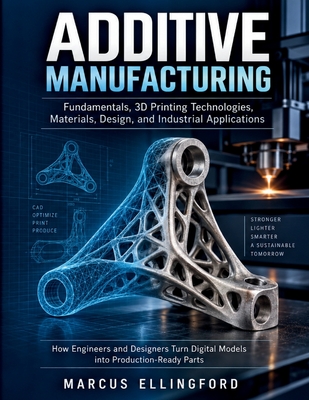
A model can look flawless on screen and still fail on the build plate, in post-processing, or in service. Layers separate under load. A part lifts and warps. A geometry that passed every design review traps powder in a channel no tool can reach. These are not printer faults. They are the predictable consequences of physics that layer-based fabrication introduces, and that conventional manufacturing training never had reason to cover.
Most engineers meet additive manufacturing at work rather than in a structured course, and the available reading sits at two extremes: consumer guides that stop at printer settings, or specialist research written for people who already have the foundation. This book closes the gap between them. It develops additive manufacturing as an engineering discipline in its own right, with its own governing physics, its own materials behaviour and its own design logic, across fifteen sequenced chapters that run from digital model to qualified production part.
What you will be able to doCoverage runs from the digital thread and all seven major process categories through polymer and metal materials science, design for additive manufacturing, computational design, mechanical behaviour, qualification practice, aerospace, medical, automotive and tooling applications, and the cost, material efficiency and lifecycle reasoning behind adoption decisions.
Learning objectives open each chapter. Worked examples show every step with units tracked and customary and metric values side by side. Practice problems with verified answers close each chapter. A glossary, unit conversion reference, material property reference and process selection quick-reference make it usable as a desk reference long after a first reading.
It is written for practising mechanical, manufacturing, design, production and quality engineers, industrial designers and product developers, engineers moving into additive production, and advanced students who need genuine technical fluency rather than an overview.
Add this reference to your engineering shelf and begin working through the physics, materials and design decisions that determine whether an additively manufactured part succeeds in service.
Log in to write a review for this book.
No reviews yet. Be the first to share your opinion.
Biography not available.