Cazòrla, Asia Author
Biography not available.

Browse all FOLKLORE books
Browse all GARDENS books
Browse all GRAPHIC NOVELS books
Browse all HISTORY - MEDIEVAL books
Browse all HUMOUR books
Browse all Juvenile Fiction : Biographical - Other books
Browse all Juvenile Fiction : Historical - Other books
Browse all Juvenile Fiction : Legends, Myths, & Fables - Other books
Browse all Juvenile Fiction : People & Places - Other books
Browse all Juvenile Fiction : People & Places - United States - Other books
Browse all Juvenile Fiction : Religious - Other books
Browse all Juvenile Nonfiction : History - Other books
Browse all Juvenile Nonfiction : Mathematics - Advanced books
Browse all Juvenile Nonfiction : People & Places - Other books
Browse all Juvenile Nonfiction : People & Places - United States - Othe books
Browse all LITERARY STUDIES books
Browse all LONDON books
Browse all Medical : Nursing - Mental Health books
Browse all MIND books
Browse all MUSEOLOGY books
Browse all NON-CLASSIFIABLE books
Browse all NONLINEAR SCIENCE books
Browse all POPULAR SCIENCE books
Browse all RELIGIOUS STUDIES books
Browse all SPIRIT books
Browse all SPORT books
Browse all TRAVEL WRITING books
 Out of Stock
Paperback · ISBN 9798174568204
Inclusive of GST and other taxes
Arriving at your doorstep in 10-15 days
Our logisitcs team will make sure everyitem is delivered safely
| ISBN | 9798174568204 |
|---|---|
| Publisher | Independently published |
| Publication date | September 2026 |
| Language | English |
| MRP | £14.81 GBP |
| Page count | 94 |
| Item weight | 31 g |
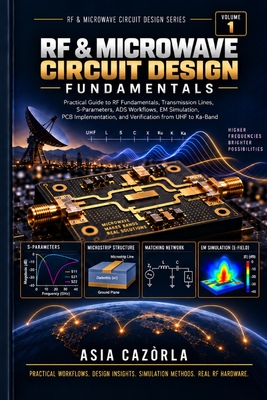
RF & Microwave Circuit Design Fundamentals is the first volume of the RF & Microwave Circuit Design Series, a practical collection focused on RF and microwave engineering from UHF to Ka-band.
Modern RF design requires more than equations and ideal circuit models. As frequency increases, PCB geometry, substrate properties, transmission-line structures, vias, pads, connectors, grounding, fabrication tolerances, and measurement conditions increasingly become part of the circuit itself.
This book introduces a compact engineering methodology for moving from an initial RF concept to a physically meaningful and verifiable implementation.
Rather than emphasizing long mathematical derivations, it focuses on practical design decisions, simulation strategy, and the physical effects that dominate real RF hardware.
You will learn about:
- wavelength, electrical length, impedance, reflection, loss, and distributed behavior;
- practical interpretation of S-parameters;
- microstrip, stripline, and grounded coplanar waveguide;
- substrate properties, dielectric loss, copper thickness, and roughness;
- bends, pads, vias, connector launches, and other discontinuities;
- grounding and return-current behavior;
- ADS, planar EM simulation, and HFSS;
- manufacturing tolerances and measurement correlation.
A central concept is the Model Fidelity Ladder:
Analytical Model → Circuit Simulation → Physical Transmission-Line Model → Planar EM → 3D Full-Wave EM → Measurement Correlation
The goal is to use the simplest model that can reliably answer the engineering question, increasing fidelity only when geometry, coupling, tolerances, or three-dimensional effects require it.
The book also explains how design priorities change from UHF to microwave and millimeter-wave frequencies. At higher frequencies, connector launches, vias, pad geometry, grounding structures, material properties, and fabrication tolerances can strongly influence circuit performance.
The practical workflow is:
Requirements → Initial Model → Circuit Simulation → Physical Layout → EM Verification → Optimization → Manufacturing Awareness → Measurement
Dedicated Design Insight sections highlight practical lessons and common engineering pitfalls.
This book is intended for RF and microwave engineers, PCB and hardware designers, electronics engineers, advanced students, and professionals using tools such as ADS, Momentum, HFSS, or similar simulation environments.
RF & Microwave Circuit Design Fundamentals establishes the methodology used throughout the series and prepares the reader for later volumes on impedance matching, filters, power dividers, directional couplers, antennas, low-noise amplifiers, and Ka-band PCB circuits.
The objective is not simply to explain how RF circuits work, but to show how they are modeled, simulated, implemented, optimized, measured, and verified as real engineering structures.
Log in to write a review for this book.
No reviews yet. Be the first to share your opinion.
Biography not available.
Biography not available.