R. Whitmore, Dr. Evelyn Author
Biography not available.

Browse all FOLKLORE books
Browse all GARDENS books
Browse all GRAPHIC NOVELS books
Browse all HISTORY - MEDIEVAL books
Browse all HUMOUR books
Browse all Juvenile Fiction : Biographical - Other books
Browse all Juvenile Fiction : Historical - Other books
Browse all Juvenile Fiction : Legends, Myths, & Fables - Other books
Browse all Juvenile Fiction : People & Places - Other books
Browse all Juvenile Fiction : People & Places - United States - Other books
Browse all Juvenile Fiction : Religious - Other books
Browse all Juvenile Nonfiction : History - Other books
Browse all Juvenile Nonfiction : Mathematics - Advanced books
Browse all Juvenile Nonfiction : People & Places - Other books
Browse all Juvenile Nonfiction : People & Places - United States - Othe books
Browse all LITERARY STUDIES books
Browse all LONDON books
Browse all Medical : Nursing - Mental Health books
Browse all MIND books
Browse all MUSEOLOGY books
Browse all NON-CLASSIFIABLE books
Browse all NONLINEAR SCIENCE books
Browse all POPULAR SCIENCE books
Browse all RELIGIOUS STUDIES books
Browse all SPIRIT books
Browse all SPORT books
Browse all TRAVEL WRITING books
 Out of Stock
Paperback · ISBN 9798174987258
Inclusive of GST and other taxes
Arriving at your doorstep in 10-15 days
Our logisitcs team will make sure everyitem is delivered safely
| ISBN | 9798174987258 |
|---|---|
| Publisher | Independently published |
| Publication date | September 2026 |
| Language | English |
| MRP | £149.44 GBP |
| Page count | 194 |
| Item weight | 102 g |
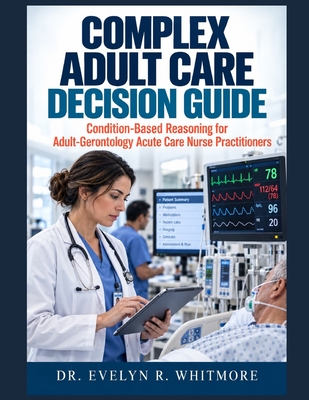
A hospitalized adult becomes suddenly breathless, confused, hypotensive, or metabolically unstable, and the first task is to turn that presentation into a short, revisable set of possibilities while action is already underway. Complex Adult Care Decision Guide is built for that moment. Written for Adult-Gerontology Acute Care Nurse Practitioners and advanced graduate nursing students, it organizes reasoning by presenting problem and condition domain, moving from what is visible now to what must be clarified next.
The scene does not stay still, so the book does not treat one value as the whole story. A first assessment leads into a presentation-to-condition decision map; a concrete trigger leads into a consultation threshold table; serial reassessment moves through a trend interpretation worksheet. The method repeats across respiratory, cardiovascular, neurologic, renal/metabolic/endocrine, and infection/multisystem presentations without turning the page into a standing order.
Follow the picture as it changesThe guide begins with undifferentiated instability, where uncertainty is highest and several dangerous explanations may still be plausible. From there, the condition-domain chapters narrow the work: acute respiratory compromise, perfusion and cardiac presentations, altered mental status and neurologic change, metabolic and endocrine derangement, and multisystem deterioration. Worked cases show impressions being revised as evidence accumulates, while documentation prompt sets turn the reasoning into language that can be handed to a colleague who was not present for the earlier data points.
Consultation is treated as part of reasoning, not as an admission that reasoning failed. Threshold tables pair observable triggers with the team or specialty to involve and the urgency of that involvement, while the recurring scope-boundary method asks whether a decision is supported by current guidance, local privilege, and the reader's own practice authority. Evidence labels distinguish law or regulation, standards, professional guidance, consensus, institutional policy, and author synthesis so that the source behind a recommendation remains visible.
What you can work through in the guide
This is an educational clinical reference, not individualized medical advice or a substitute for institutional protocol, specialty guidance, scope-of-practice rules, or direct clinical judgment. Numeric thresholds and guideline statements must be checked against current sources before use in patient care. The book's contribution is the retrieval structure around that judgment: a repeatable way to see the next question, record the trend, recognize when additional expertise belongs in the decision, and keep the reference itself open to revision as standards change.
Log in to write a review for this book.
No reviews yet. Be the first to share your opinion.
Biography not available.