Alrukh, Yousf Author
Biography not available.

Browse all FOLKLORE books
Browse all GARDENS books
Browse all GRAPHIC NOVELS books
Browse all HISTORY - MEDIEVAL books
Browse all HUMOUR books
Browse all Juvenile Fiction : Biographical - Other books
Browse all Juvenile Fiction : Historical - Other books
Browse all Juvenile Fiction : Legends, Myths, & Fables - Other books
Browse all Juvenile Fiction : People & Places - Other books
Browse all Juvenile Fiction : People & Places - United States - Other books
Browse all Juvenile Fiction : Religious - Other books
Browse all Juvenile Nonfiction : History - Other books
Browse all Juvenile Nonfiction : Mathematics - Advanced books
Browse all Juvenile Nonfiction : People & Places - Other books
Browse all Juvenile Nonfiction : People & Places - United States - Othe books
Browse all LITERARY STUDIES books
Browse all LONDON books
Browse all Medical : Nursing - Mental Health books
Browse all MIND books
Browse all MUSEOLOGY books
Browse all NON-CLASSIFIABLE books
Browse all NONLINEAR SCIENCE books
Browse all POPULAR SCIENCE books
Browse all RELIGIOUS STUDIES books
Browse all SPIRIT books
Browse all SPORT books
Browse all TRAVEL WRITING books
 Out of Stock
Paperback · ISBN 9798175987912
Inclusive of GST and other taxes
Arriving at your doorstep in 10-15 days
Our logisitcs team will make sure everyitem is delivered safely
| ISBN | 9798175987912 |
|---|---|
| Publisher | Independently published |
| Publication date | September 2026 |
| Language | English |
| MRP | £9.70 GBP |
| Page count | 78 |
| Item weight | 26 g |
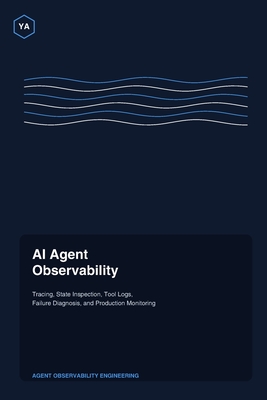
The book focuses on the observability signals and engineering practices needed to understand not only whether an AI agent completed a task, but what happened throughout its execution.
You will explore:
- Distributed tracing and trace context propagation
- State inspection and memory snapshots
- Tool and action logs
- Structured events and execution records
- Task success, latency, cost, and retry metrics
- Failure diagnosis and root-cause analysis
- Privacy-aware telemetry and data retention
- Alerting and anomaly detection
- Reliability review
- Production observability platforms
- Observability for multi-agent systems
The book emphasizes investigation-driven observability: capturing the information an engineer will actually need when diagnosing a real failure rather than relying on convenient logs that leave critical gaps.
Each chapter explains the concept, how it works in practice, the engineering trade-off involved, common pitfalls, and practical checks. Worked scenarios show how observability decisions affect real production investigations.
AI Agent Observability is designed for engineers, developers, AI system builders, and technical teams working with agentic systems who need a clearer way to understand execution, investigate failures, and monitor AI agents in production.
Log in to write a review for this book.
No reviews yet. Be the first to share your opinion.
Biography not available.