K. Vale, Jonathan Author
Biography not available.

Browse all FOLKLORE books
Browse all GARDENS books
Browse all GRAPHIC NOVELS books
Browse all HISTORY - MEDIEVAL books
Browse all HUMOUR books
Browse all Juvenile Fiction : Biographical - Other books
Browse all Juvenile Fiction : Historical - Other books
Browse all Juvenile Fiction : Legends, Myths, & Fables - Other books
Browse all Juvenile Fiction : People & Places - Other books
Browse all Juvenile Fiction : People & Places - United States - Other books
Browse all Juvenile Fiction : Religious - Other books
Browse all Juvenile Nonfiction : History - Other books
Browse all Juvenile Nonfiction : Mathematics - Advanced books
Browse all Juvenile Nonfiction : People & Places - Other books
Browse all Juvenile Nonfiction : People & Places - United States - Othe books
Browse all LITERARY STUDIES books
Browse all LONDON books
Browse all Medical : Nursing - Mental Health books
Browse all MIND books
Browse all MUSEOLOGY books
Browse all NON-CLASSIFIABLE books
Browse all NONLINEAR SCIENCE books
Browse all POPULAR SCIENCE books
Browse all RELIGIOUS STUDIES books
Browse all SPIRIT books
Browse all SPORT books
Browse all TRAVEL WRITING books
 Out of Stock
Paperback · ISBN 9798176597875
Inclusive of GST and other taxes
Arriving at your doorstep in 10-15 days
Our logisitcs team will make sure everyitem is delivered safely
| ISBN | 9798176597875 |
|---|---|
| Publisher | Independently published |
| Publication date | September 2026 |
| Language | English |
| MRP | £74.93 GBP |
| Page count | 482 |
| Item weight | 244 g |
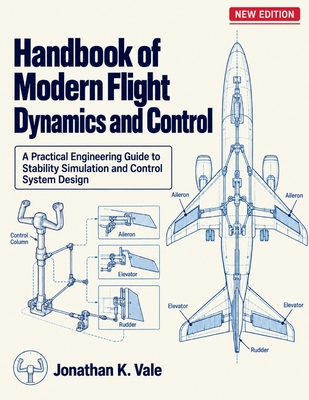
What turns a flight dynamics calculation into engineering evidence that another person can reproduce, challenge, and use?
The answer requires more than a correct formula. Aircraft behavior emerges from interacting aerodynamics, mechanics, propulsion, atmosphere, sensors, actuators, computation, feedback, and human operation. A useful model must match the decision being made, and a useful control design must account for the limits, delays, uncertainty, and failure behavior that shape the complete system.
This practical handbook shows how to connect those elements in a repeatable workflow. Each major topic begins with stated assumptions, develops the governing relationships, and carries the result into numerical implementation, physical interpretation, testing, and acceptance evidence. The approach remains software neutral so the reader can apply the methods in a suitable analysis or simulation environment.
What this handbook helps you do:Readers work through coordinate transformations, attitude representation, six degree of freedom motion, force and moment models, propulsion, actuator dynamics, trim maps, linearization, state space models, aircraft modes, atmospheric disturbance response, numerical integration, system identification, classical feedback, autopilots, path guidance, multivariable design, sensor fusion, constrained allocation, uncertainty, flexible aircraft, development assurance, pilot automation interaction, and certification oriented evidence. Four independently constructed reference configurations provide varied examples without being presented as approved aircraft data.
This book is written for advanced aerospace students and working engineers who need both derivation and application. It also serves instructors building a flight dynamics or control course, researchers developing simulation and estimation methods, and reviewers who must trace a technical claim back to assumptions, data, configuration, and test evidence.
Open the handbook and start applying a disciplined model analyze design verify workflow to the aircraft dynamics and control questions that matter in your study or engineering work.
Log in to write a review for this book.
No reviews yet. Be the first to share your opinion.
Biography not available.