Keller, Adrian Author
Biography not available.

Browse all FOLKLORE books
Browse all GARDENS books
Browse all GRAPHIC NOVELS books
Browse all HISTORY - MEDIEVAL books
Browse all HUMOUR books
Browse all Juvenile Fiction : Biographical - Other books
Browse all Juvenile Fiction : Historical - Other books
Browse all Juvenile Fiction : Legends, Myths, & Fables - Other books
Browse all Juvenile Fiction : People & Places - Other books
Browse all Juvenile Fiction : People & Places - United States - Other books
Browse all Juvenile Fiction : Religious - Other books
Browse all Juvenile Nonfiction : History - Other books
Browse all Juvenile Nonfiction : Mathematics - Advanced books
Browse all Juvenile Nonfiction : People & Places - Other books
Browse all Juvenile Nonfiction : People & Places - United States - Othe books
Browse all LITERARY STUDIES books
Browse all LONDON books
Browse all Medical : Nursing - Mental Health books
Browse all MIND books
Browse all MUSEOLOGY books
Browse all NON-CLASSIFIABLE books
Browse all NONLINEAR SCIENCE books
Browse all POPULAR SCIENCE books
Browse all RELIGIOUS STUDIES books
Browse all SPIRIT books
Browse all SPORT books
Browse all TRAVEL WRITING books
 Out of Stock
Paperback · ISBN 9798178611586
Inclusive of GST and other taxes
Arriving at your doorstep in 10-15 days
Our logisitcs team will make sure everyitem is delivered safely
| ISBN | 9798178611586 |
|---|---|
| Publisher | Independently published |
| Publication date | October 2026 |
| Language | English |
| MRP | £12.83 GBP |
| Page count | 98 |
| Item weight | 32 g |
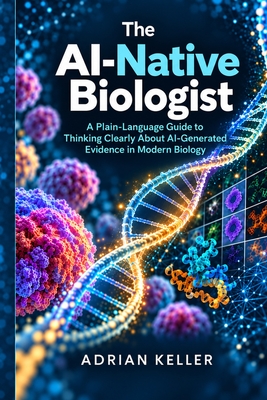
The AI-Native Biologist is a plain-language guide to thinking clearly about AI-generated evidence in modern biology. Rather than teaching code or a particular software platform, Adrian Keller focuses on principles that outlast rapidly changing tools: how biological reality becomes data, how representations shape what models can learn, why confident predictions can still fail, how shortcut learning and distribution shift mislead, and how experiments turn computational possibilities into scientific knowledge.
Through examples from protein structure, single-cell biology, imaging, drug discovery, generative models, active learning, and automated laboratories, the book develops a practical framework - the Bio-AI Canvas - for moving from questions and measurements to predictions, uncertainty, checks, and better experiments.
For biologists, life scientists, students, and curious readers who want to work productively with AI while remaining anchored in evidence.
Log in to write a review for this book.
No reviews yet. Be the first to share your opinion.
Biography not available.