NEER, TIM Author
Biography not available.

Browse all FOLKLORE books
Browse all GARDENS books
Browse all GRAPHIC NOVELS books
Browse all HISTORY - MEDIEVAL books
Browse all HUMOUR books
Browse all Juvenile Fiction : Biographical - Other books
Browse all Juvenile Fiction : Historical - Other books
Browse all Juvenile Fiction : Legends, Myths, & Fables - Other books
Browse all Juvenile Fiction : People & Places - Other books
Browse all Juvenile Fiction : People & Places - United States - Other books
Browse all Juvenile Fiction : Religious - Other books
Browse all Juvenile Nonfiction : History - Other books
Browse all Juvenile Nonfiction : Mathematics - Advanced books
Browse all Juvenile Nonfiction : People & Places - Other books
Browse all Juvenile Nonfiction : People & Places - United States - Othe books
Browse all LITERARY STUDIES books
Browse all LONDON books
Browse all Medical : Nursing - Mental Health books
Browse all MIND books
Browse all MUSEOLOGY books
Browse all NON-CLASSIFIABLE books
Browse all NONLINEAR SCIENCE books
Browse all POPULAR SCIENCE books
Browse all RELIGIOUS STUDIES books
Browse all SPIRIT books
Browse all SPORT books
Browse all TRAVEL WRITING books
 Out of Stock
Paperback · ISBN 9798178741191
Inclusive of GST and other taxes
Arriving at your doorstep in 10-15 days
Our logisitcs team will make sure everyitem is delivered safely
| ISBN | 9798178741191 |
|---|---|
| Publisher | Independently published |
| Publication date | October 2026 |
| Language | English |
| MRP | £86.27 GBP |
| Page count | 410 |
| Item weight | 209 g |
Understand what the engine room is telling you, one connected system at a time.
Knowing the names of engines, pumps and generators is a useful start. The next challenge is explaining how they work together, what a changing reading means and why a fault in one service can affect several others. A beginner needs a clear way to connect engineering theory with the behaviour of the whole plant.
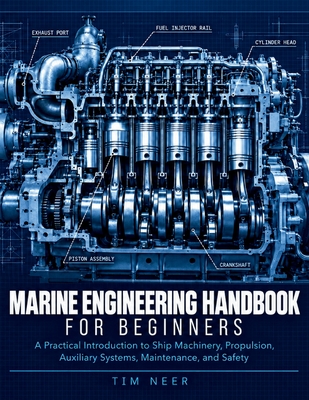
This handbook builds that foundation through fifteen chapters covering propulsion, support circuits, ship services and professional practice. Explanations, simplified diagrams, tables and worked calculations show how the principles apply. Practice problems with answers help you test your reasoning, while a recurring method of tracing energy, fluids and control signals keeps the topics connected.
Key topics include combustion, turbocharging, starting air, piping and valves, bilge and ballast systems, boilers, steam and freshwater production. Refrigeration, ventilation, deck machinery and environmental services extend the discussion beyond the main engine. Pollution prevention and energy-efficiency examples connect everyday equipment condition with the wider ship, while alternative fuels, batteries and hybrid propulsion introduce changing technology and its hazards.
Learning objectives and chapter summaries support a structured first reading. Formula and symbol tables, a glossary and regional unit conversions provide reference material for returning to a calculation or unfamiliar term. Throughout, the emphasis is on following the system and interpreting evidence before drawing conclusions about a component.
Written for engine cadets, first-year students, technically curious seafarers and readers beginning machinery-space study, this is an educational foundation for use alongside supervised training, approved vessel procedures and equipment manuals. The book explains principles and reasoning; actual settings, maintenance limits and operating actions require the current information for the vessel and equipment concerned.
Get your copy and begin tracing the systems behind the readings, then use the examples and questions to build a clearer understanding of the ship's engineering plant.
Log in to write a review for this book.
No reviews yet. Be the first to share your opinion.
Biography not available.