Snow, Isha Author
Biography not available.

Browse all FOLKLORE books
Browse all GARDENS books
Browse all GRAPHIC NOVELS books
Browse all HISTORY - MEDIEVAL books
Browse all HUMOUR books
Browse all Juvenile Fiction : Biographical - Other books
Browse all Juvenile Fiction : Historical - Other books
Browse all Juvenile Fiction : Legends, Myths, & Fables - Other books
Browse all Juvenile Fiction : People & Places - Other books
Browse all Juvenile Fiction : People & Places - United States - Other books
Browse all Juvenile Fiction : Religious - Other books
Browse all Juvenile Nonfiction : History - Other books
Browse all Juvenile Nonfiction : Mathematics - Advanced books
Browse all Juvenile Nonfiction : People & Places - Other books
Browse all Juvenile Nonfiction : People & Places - United States - Othe books
Browse all LITERARY STUDIES books
Browse all LONDON books
Browse all Medical : Nursing - Mental Health books
Browse all MIND books
Browse all MUSEOLOGY books
Browse all NON-CLASSIFIABLE books
Browse all NONLINEAR SCIENCE books
Browse all POPULAR SCIENCE books
Browse all RELIGIOUS STUDIES books
Browse all SPIRIT books
Browse all SPORT books
Browse all TRAVEL WRITING books
 Out of Stock
Paperback · ISBN 9798241122322
Inclusive of GST and other taxes
Arriving at your doorstep in 10-15 days
Our logisitcs team will make sure everyitem is delivered safely
| ISBN | 9798241122322 |
|---|---|
| Publisher | Independently published |
| Publication date | December 2025 |
| Language | English |
| MRP | £106.89 GBP |
| Page count | 800 |
| Item weight | 323 g |
by Isha Sarah Snow
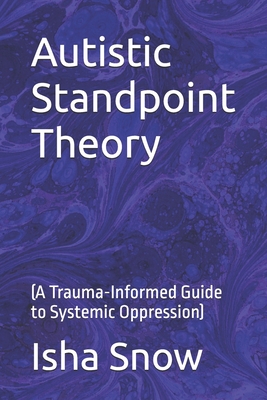
What if autism is not a disorder located in individual bodies, but a signal of systemic failure in how modern societies organize collective development, care, and human connection?
Autistic Standpoint Theory is a groundbreaking, interdisciplinary work that reframes autism through sociology, anthropology, attachment science, trauma-informed neuroscience, and human rights analysis. Drawing from the first seventy-two essays of Isha Sarah Snow's new and already widely read Substack publication by the same title, this book advances a cohesive theoretical framework that challenges deficit-based psychology and exposes how Western social systems pathologize predictable responses to relational deprivation.
Building on the arguments introduced in Snow's first book, Autism in America: One Woman's Search for Healing, this volume moves from cultural critique to deeper structural analysis. Snow demonstrates how policies and institutions shaped by colonial cognition, hyper-individualism, and behaviorist ideology systematically undermine early attachment, fracture nervous-system development, and moralize distress. Autism, in this framework, emerges not as a mystery or an epidemic, but as a social-ecological indicator revealing widespread developmental discordance between human evolutionary needs and modern governance.
Through concepts such as childism, recursive repair, relational accountability, and the collective nervous system, Autistic Standpoint Theory connects rising autism prevalence to broader patterns of class inequality, institutional violence, and human rights violations. The book argues that class warfare is enacted not only through poverty, marginalization, and economic exploitation, but also through the privatization of care and the erosion of relational infrastructure, producing populations that are emotionally fragmented, relationally ruptured, socially divided, and therefore easier to govern through fear and punishment.
This work is not a diagnostic manual and does not deny biological diversity. Instead, it offers a relational lens that integrates lived autistic experience with rigorous scholarship, positioning autistic perception as a legitimate epistemic standpoint capable of exposing contradictions that dominant systems normalize and obscure.
Written at the intersection of memoir, theory, and public-facing scholarship, Autistic Standpoint Theory is both an analytical framework and a call to action. It invites readers to reconsider what we define as normal, healthy, and functional, and to imagine systems of education, mental health, and governance grounded in attunement, dignity, and collective care.
For readers of:
- autism and neurodiversity studies
- trauma-informed psychology
- sociology and anthropology
- disability justice and human rights
- decolonial and systems theory
Log in to write a review for this book.
No reviews yet. Be the first to share your opinion.
Biography not available.