Singh, Mayank Author
Biography not available.

Browse all FOLKLORE books
Browse all GARDENS books
Browse all GRAPHIC NOVELS books
Browse all HISTORY - MEDIEVAL books
Browse all HUMOUR books
Browse all Juvenile Fiction : Biographical - Other books
Browse all Juvenile Fiction : Historical - Other books
Browse all Juvenile Fiction : Legends, Myths, & Fables - Other books
Browse all Juvenile Fiction : People & Places - Other books
Browse all Juvenile Fiction : People & Places - United States - Other books
Browse all Juvenile Fiction : Religious - Other books
Browse all Juvenile Nonfiction : History - Other books
Browse all Juvenile Nonfiction : Mathematics - Advanced books
Browse all Juvenile Nonfiction : People & Places - Other books
Browse all Juvenile Nonfiction : People & Places - United States - Othe books
Browse all LITERARY STUDIES books
Browse all LONDON books
Browse all Medical : Nursing - Mental Health books
Browse all MIND books
Browse all MUSEOLOGY books
Browse all NON-CLASSIFIABLE books
Browse all NONLINEAR SCIENCE books
Browse all POPULAR SCIENCE books
Browse all RELIGIOUS STUDIES books
Browse all SPIRIT books
Browse all SPORT books
Browse all TRAVEL WRITING books
 Out of Stock
Paperback · ISBN 9798247441755
Inclusive of GST and other taxes
Arriving at your doorstep in 10-15 days
Our logisitcs team will make sure everyitem is delivered safely
| ISBN | 9798247441755 |
|---|---|
| Publisher | Independently published |
| Publication date | February 2026 |
| Language | English |
| MRP | £4.83 GBP |
| Page count | 86 |
| Item weight | 28 g |
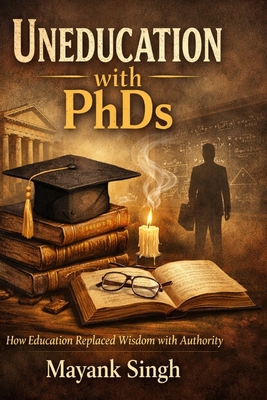
Uneducation with PhDs is a philosophical inquiry into modern education and its hidden psychological structure.
Rather than treating education as a system in need of reform, this book examines it as a conditioning process-one that gradually replaces intelligence with authority, curiosity with compliance, and understanding with memorisation. It asks a question rarely confronted directly: why has the expansion of education not produced a parallel expansion of clarity, wisdom, or ethical maturity?
Moving beyond policy critique, the work analyzes how teaching becomes a mechanism of obedience, how morality is shaped through conditioning rather than insight, and how higher degrees often narrow perception instead of deepening it. From classrooms to academia, from examinations to expertise, the book traces how intelligence is contained, redirected, and ultimately subordinated to institutional validation.
This is not a guide, a self-help manual, or a political manifesto. It offers no solutions, frameworks, or prescriptions. Its purpose is diagnostic-to expose patterns that are normalized and therefore rarely questioned. The chapters are written not to persuade, but to observe carefully how modern education structures thought, identity, and power.
Uneducation with PhDs is for readers interested in philosophy, critical inquiry, education theory, and the psychology of authority. It challenges the assumption that knowledge equals understanding and invites the reader to examine the difference between being educated and being intelligent.
This book does not ask for agreement. It asks for attention.
Log in to write a review for this book.
No reviews yet. Be the first to share your opinion.
Biography not available.