Milne James S Author
Biography not available.

Browse all ART CRITICISM books
Browse all Ashworth books
Browse all FOLKLORE books
Browse all GARDENS books
Browse all GRAPHIC NOVELS books
Browse all Hamilton books
Browse all HISTORY - MEDIEVAL books
Browse all HUMOUR books
Browse all KINDRED books
Browse all LITERARY STUDIES books
Browse all LONDON books
Browse all Lozada books
Browse all Medical : Nursing - Mental Health books
Browse all MIND books
Browse all MUSEOLOGY books
Browse all NON-CLASSIFIABLE books
Browse all NONLINEAR SCIENCE books
Browse all Ormonde books
Browse all POPULAR SCIENCE books
Browse all RELIGIOUS STUDIES books
Browse all SPIRIT books
Browse all SPORT books
Browse all TRAVEL WRITING books
 Out of Stock
Paperback · ISBN 9798886130843
Inclusive of GST and other taxes
Arriving at your doorstep in 2-3 days
Our logisitcs team will make sure everyitem is delivered safely
| ISBN | 9798886130843 |
|---|---|
| Publisher | World Scientific |
| Language | English |
| Page count | 320 |
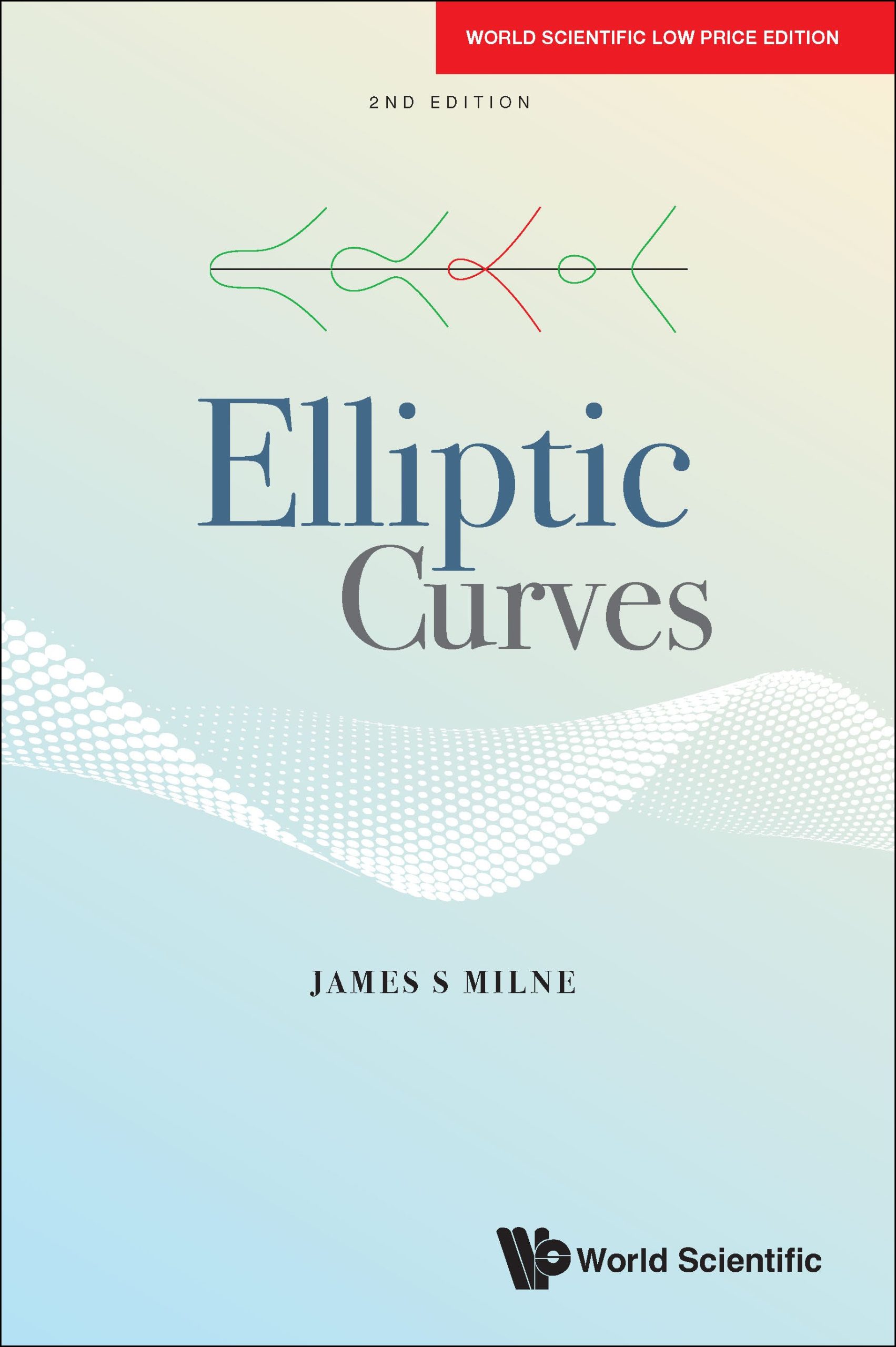
This book uses the beautiful theory of elliptic curves to introduce the reader to some of the deeper aspects of number theory. It assumes only a knowledge of the basic algebra, complex analysis, and topology usually taught in first-year graduate courses. An elliptic curve is a plane curve defined by a cubic polynomial. Although the problem of finding the rational points on an elliptic curve has fascinated mathematicians since ancient times, it was not until 1922 that Mordell proved that the points form a finitely generated group. There is still no proven algorithm for finding the rank of the group, but in one of the earliest important applications of computers to mathematics, Birch and Swinnerton-Dyer discovered a relation between the rank and the numbers of points on the curve computed modulo a prime. Chapter IV of the book proves Mordell's theorem and explains the conjecture of Birch and Swinnerton-Dyer. Every elliptic curve over the rational numbers has an L-series attached to it.Hasse conjectured that this L-series satisfies a functional equation, and in 1955 Taniyama suggested that Hasse's conjecture could be proved by showing that the L-series arises from a modular form. This was shown to be correct by Wiles (and others) in the 1990s, and, as a consequence, one obtains a proof of Fermat's Last Theorem. Chapter V of the book is devoted to explaining this work. The first three chapters develop the basic theory of elliptic curves. For this edition, the text has been completely revised and updated.
Log in to write a review for this book.
No reviews yet. Be the first to share your opinion.
Biography not available.